
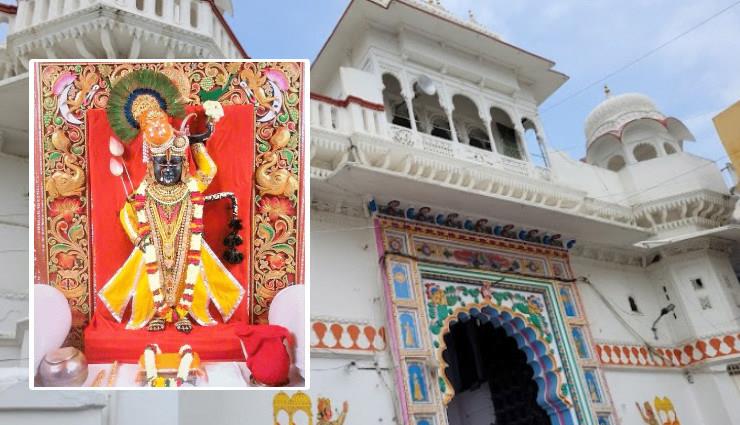
Srinathji Temple is the most iconic temple of Lord Krishna in Rajasthan and the prominent seat of the Vallabha Sampradaya. It is the temple which houses one of the rarest worshipable Deity forms of Lord Sri Krishna – The Govardhana Giridhari.
Srinathji Temple is a magnificent temple dedicated to Lord Srinath ji, an unique form of Lord Sri Krishna, who is standing with Govardhana mountain in His left hand. It is located in the sacred temple town of Nathdwara, also known as Srinathdwara, in the Rajsamand District of Rajasthan. It is the most celebrated temple of Lord Krishna in Rajasthan and all over the world.
Unique features of Srinathji’s Deity
The stunning Deity of Srinath ji was carved by Vajranabha, the great grandson of Sri Krishna and originally installed atop the Govardhana Hill within Vrajabhumi. This is a black marble Deity, showcasing Lord Sri Krishna with two hands – the left hand is raised portraying the classic pose of lifting Govardhana Hill and the right hand is kept on the waist. Srinath ji’s eyes are bent downwards, casting His merciful glance on His devotees. They are known as kripa kataaksha netra. Some devotees say that out of shyness Lord Krishna’s eyes are bent, as He could not look into the charming eyes of Srimati Radharani while lifting the Govardhana Hill.

Sthala Purana of Srinathji Temple
The Deity of Srinathji was initially worshiped at the Govardhana Hill, located in the Mathura district of Uttar Pradesh. It was originally established by Vajranabha five thousand years ago, remembering the Govardhana Lila of Lord Sri Krishna. As the time passed by, the Deity got lost and it was rediscovered by Srila Madhavendra Puri, who reestablished atop Govardhana Hill, around 550 years back. In 1672 CE, Srinathji was moved from Mathura to Agra via the Yamuna River to protect it from Aurangzeb’s iconoclastic campaigns. The Deity remained in Agra for approximately six months. From Agra, the Deity was then moved to Sihad (Nathdwara) by bullock cart. At this sacred Sihad village, the wheels of the bullock cart, carrying Srinathji, sank deeply into the earth, and no matter the efforts, it couldn’t be moved further. This was considered a divine sign that the Lord wished to dwell here as this place looked like Vrindavana. Maharana Raj Singh of Mewar in 1672 CE, constructed this magnificent temple.
Architecture of Srinathji Temple
Surprisingly the architecture of Srinathji temple looks like a simple house and not the regular temple. This is because, the King of Mewar, did not want Aurangzeb to discover the whereabouts of Srinathji and come looking to destroy the Deity. Yet, the architecture of Srinathji Temple is a representation of Haveli architecture, an elegance of Rajput Gharana. Therefore the temple is also called as Srinathji ki Haveli.
Just like a house, Srinathji temple has various rooms (Seva Kunj) that are reserved for different purposes connected to the daily rituals of Srinath ji.
- Paanghar: A storeroom for paan or betel leaves.
- Doodhghar: A storeroom reserved for milk storage.
- Mishrighar: It is reserved for storing sugar.
- Pedaghar: A room for storing sweetmeats.
- Poolghar: A storeroom for flowers.
- Rasoighar: The kitchen area.
- Gahnaghar: A jewelry chamber.
- Karcha Bhandaar: The treasure house.
- Ashvashala: A stable for horses used in riding chariots.
- Bhaithak: A drawing or sitting room.
- Chakki: Grinding wheel made of precious metals like gold and silver.
They also have five wells used only for storing the ghee for the preparation of bhoga of the Lord. Srinathji Temple also boasts of goshala which is known all over the world for its management and care of the cows. In fact, this goshala hosts the cow breeds belonging to the generation of cows of Nanda Maharaja, five thousand years ago.

Daily rituals of Srinathji Temple
According to Pushtimarg Sampradaya, Srinathji is treated like a seven year old child, who is also a Thakurji, the Lord of the House; hence, the Lord is not worshiped here, but seva is offered to the Lord. Hence this place represents Nanda Bhavan and also called as Nandalaya.
Everyday Srinathji receives sevas beginning from mangala-arati.
Mangala Darshan: It is the first darshan and aarti of Lord Shrinath for the day. Lord Srinathji wears minimal clothing during this darshan and devotees can have peaceful darshan of the Lord.
Shringar Darshan: Shrinathji Temple is famous for the Shringar (dressing-up) of Lord Shrinathji. In this darshan, you can see the Lord in a beautiful attire after the bath. Every darshan is unique. Depending on the season and festival, Srinathji dresses Himself. For the matter of fact, this is the only temple in the world where the bhoga is offered to Srinathji to mitigate tiredness from dressing-up.
Gval Darshan: This is the time when Shrinathji wanders in the field with his cows. In Gval Darshan, devotees offer sweets and tulsi leaves to the Lord.
Rajbhog Darshan: Devotees offer food to Shrinathji in Rajbhog Darshan. This is the mealtime of the Lord.
Utthanpan Darshan: It is conducted after Lord Shrinathji wakes up from his dreams.
Bhog Darshan: Lord Sreenathji goes out to play after having his afternoon snack.
Sandhya Aarti Darshan: In this darshan, Shreenathji returns to the temple with his cows. Sandhya aarti is performed.
Shayan: After having dinner, Sreenathji goes to His sleeping chamber. This is the last public darshan available for the day.
Temple Timings of Srinathji Temple
The darshan timings of Srinathji are not fixed. They keep changing depending on the seasons and the festivals. The time is generally updated the previous day on temple’s website or put up on the board outside the temple. The general timings of the temple are as follows:
Morning: 5:30 AM to 12:30 PM
Evening: 4:00 PM to 8:30 PM
Best Time to Visit Srinathji Temple
September to February is the best time to visit Srinathji. During the winter season, the temperature will be around 26°C.
Festivals of Srinathji Temple
Holi: This is a vibrant and deeply rooted religious festival celebrated in the Phalguna month on the day of Purnima. The Deity of Srinathji is dressed in festive attire, and the temple is grandly decorated. The ritual called “dol-jhoolana” is practiced.
Diwali: During this festival, the Deity of Srinathji is adorned with chakdar jama (silver brocade) attire, diamond, ruby, and emerald ornaments, and a pearl-studded pichhvai.
Annakuta: Annakuta is the festival of Govardhana Puja, celebrated one day after Diwali. This is the grandest festival of Srinathji Temple. During the festival, the pujari of the temple offers a large pile of rice, known as Chappan Bhog (approximately 2500 kg), to Srinathji. This is celebrated as a mark of gratitude to Srinathji for saving the people of Vraja from the wrath of Indra by lifting Govardhana Hill. By evening, the prasadam is served to the devotees.
Krishna Janmashtami: It is a must-visit place during this festival, as it is celebrated with great fervor. During this festival, Srinathji is honored with a ceremonial salute of 21 gunshots.
Nearby Places to Visit
Charbhuja Temple: It is also known as Sri Charbhuja Nathji Mandir and is located in Garbhor village in Rajsamand district in Rajasthan. The main Deity is Charbhuja, the four-armed form of Lord Vishnu.
Dwarkadish Temple: It is located in Kankroli village, on the banks of Rajsamand Lake in Rajasthan. This sacred temple is dedicated to Lord Dwarkadhish. It is revered as one of the Pancha Dwarkas or Nava Dwarkas.
Sanwariya Seth Temple: This temple is dedicated to Sanwariya Seth, who is Lord Krishna Himself, and is located on the Chittorgarh – Udaipur Highway. The temple is rich in architecture and attracts thousands of devotees.
Eklingji Temple: It is a highly revered Shiva temple located in Udaipur. It has high spiritual significance. It is worshiped by the rulers of Mewar. This marvelous temple was built by Bappa Rawal, founder of the Mewar dynasty.
How to Reach Srinathji Temple?
If you plan to visit the Srinathji Temple and other sacred places, consider Tirtha Yatra’s Pancha Dwarka Yatra. All arrangements for your yatra will be well taken care of. Without any hassle your darshans shall be arranged.

However, if you prefer to travel on your own, here are a few options.
By Air: The closest airport is the Maharana Pratap Airport in Udaipur. From the airport, taxis can be hired. Even there are frequent bus facilities available to reach Nathdwara.
By Railway: Mavli Junction Railway Station (30 Kms away) and Udaipur City Railway Station (50 Kms away) are the nearest railways. From either of the railway stations, taxis or cabs can be hired to reach the destination. There are frequent buses that ply from the railway station to the temple.
By Road: It is connected to major cities like Delhi, Mumbai, Jaipur, and Ahmedabad. You can hire a taxi or an auto to reach Nathdwara.
0
Leave a Reply