
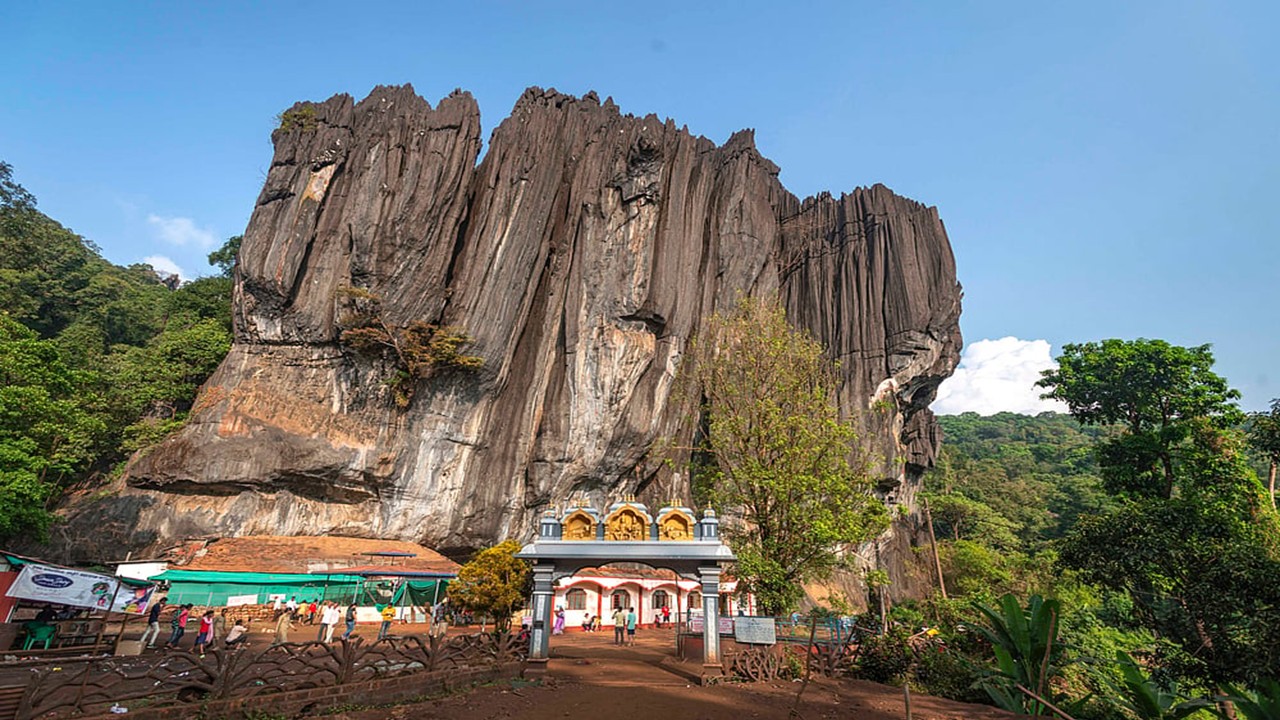
Hidden deep within the luxuriant forests of the Western Ghats in Karnataka’s Uttara Kannada district lies Yana, one of India’s most mysterious and awe-inspiring sacred landscapes. Located in the Katgal Range of Karnataka’s Malenadu region, Yana is among the world’s wettest villages. It is also regarded as Karnataka’s cleanest village and India’s second cleanest. Unlike conventional temples built by rulers and dynasties, Yana was shaped largely by nature. Towering black limestone monoliths rise above the forest canopy, creating an almost prehistoric landscape. For centuries, pilgrims, sages, and travellers have visited this remarkable site, now revered as both a pilgrimage centre and an important part of Karnataka’s heritage.
Near Kumta and Sirsi in Uttara Kannada, Yana lies in the Western Ghats’ Sahyadri range, surrounded by evergreen forests, streams, medicinal plants, and wildlife. It is among Karnataka’s wettest areas. Scientists attribute the cave’s natural Shiva linga to limestone stalactite and stalagmite formation.
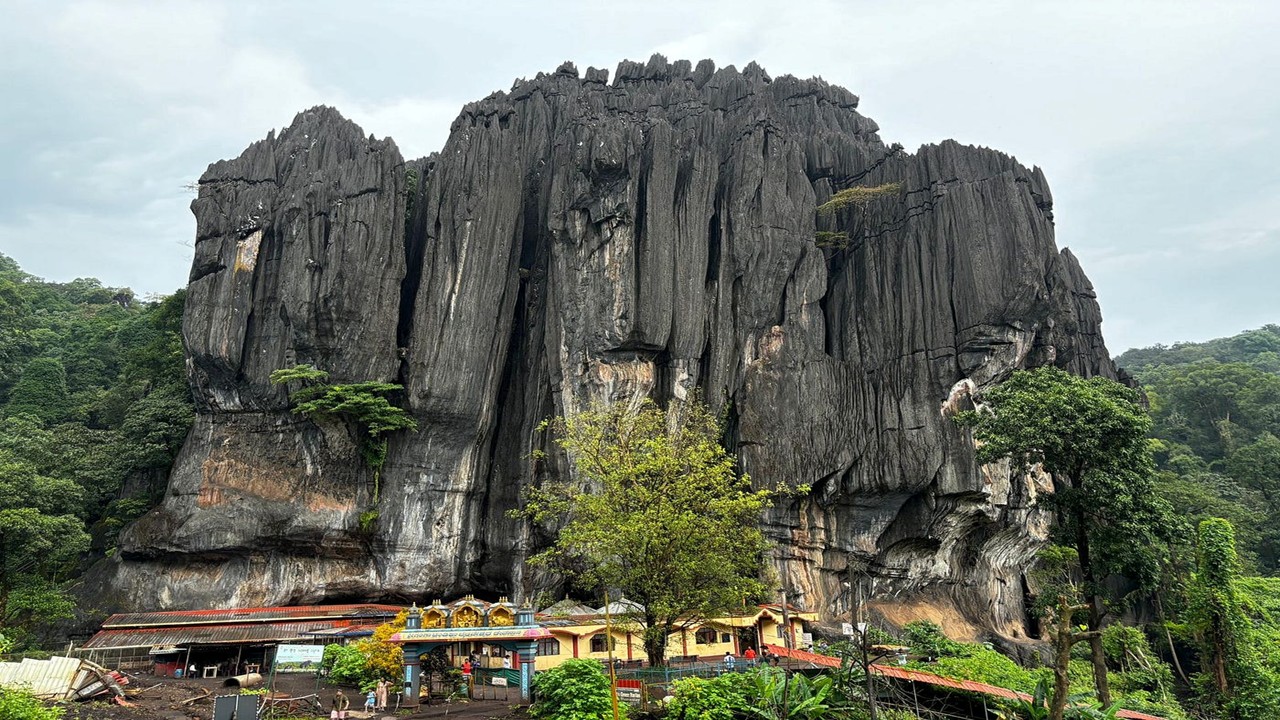
Yana’s defining features are Bhairaveshwara Shikhara, about 120 metres high, and Mohini Shikhara, about 90 metres. Composed of rare black crystalline karst limestone, these dramatic monoliths contrast with the lush forest and rank among Karnataka’s most photographed natural landmarks.
Demon Bhasmasura’s Story
The spiritual significance of Yana is rooted in the famous historical reference of Bhasmasura. According to the Puranic tradition, the demon Bhasmasura performed intense penance to please Bhagavan Shiva. Impressed by his devotion, Shiva granted him a powerful boon whereby anyone whose head he touched would instantly turn into ashes. Drunk with power, Bhasmasura soon became arrogant and decided to test the boon on Shiva himself. Realizing the danger, Bhagavan Shiva fled and sought divine intervention. Sri Vishnu then assumed the enchanting form of Mohini, the celestial enchantress, and challenged Bhasmasura to imitate her dance movements. During the dance, Mohini placed her hand upon her own head. Unthinkingly copying her actions, Bhasmasura placed his hand on his head and was immediately reduced to ashes by his own boon. Local tradition identifies Yana as the place where this divine episode occurred.
The two monumental rocks are intimately connected to this story. Bhairaveshwara Shikhara is associated with Bhagavan Shiva in his Bhairava form, while Mohini Shikhara represents Sri Vishnu’s captivating Mohini avatar. Some local traditions even maintain that the black colour of the rocks symbolizes the ashes of Bhasmasura, preserved through the ages as a reminder of the triumph of divine Dharma over Adharma.
Natural Architectural
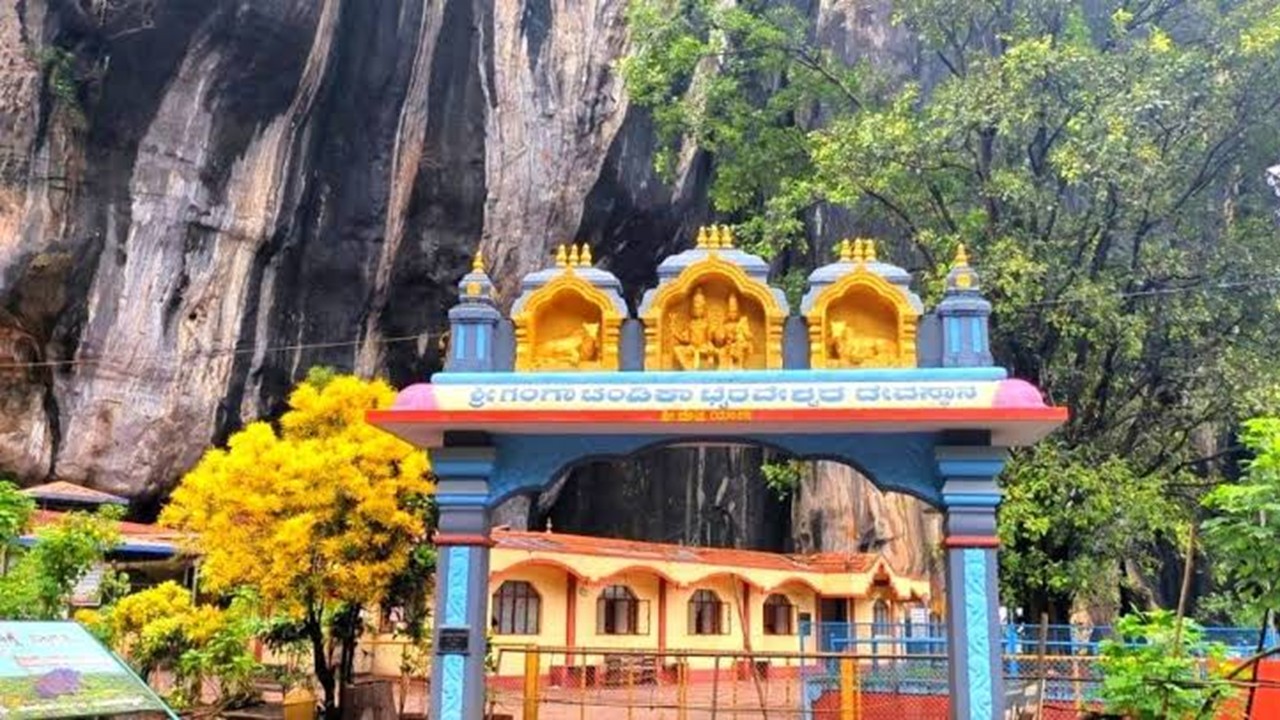
At the base of Bhairaveshwara Shikhara lies the sacred cave temple dedicated to Bhagavan Shiva. The temple’s principal deity is a Swayambhu Shiva Linga, meaning a self-manifested linga believed to have appeared naturally rather than being carved by human hands. No historical records identify a particular king or dynasty as the creator of the shrine, making it one of the rare sacred places where nature itself serves as the architect.
One of the most remarkable aspects of the cave temple is the constant dripping of water from the cave roof directly onto the Shiva Linga. Devotees regard this as a perpetual divine abhisheka performed by nature itself. The water emerges from the rock formations above, trickling gently over the sacred Linga throughout the year. Within the cave is also a bronze deity of Chandika, a fierce form of Mata Durga. There are also several other small caves nearby. There is also a Ganesha temple in the vicinity.
Architecturally, Yana differs fundamentally from most Indian temple complexes. Rather than elaborate gopurams, mandapas, or sculptured walls, the primary architectural elements are entirely natural. The immense limestone formations themselves act as towering temple spires, while the cave serves as the sanctum. About 8 km away, Vibhuti Falls – whose name means “ashes” – also draws visitors. The falls are said to take their name from the third tier, where the water divides into three streams resembling streaks of ash.
An often-overlooked aspect of Yana is its geological importance. Scientists regard the black limestone formations as exceptional examples of karst topography formed over millions of years through erosion and weathering. Recognizing this significance, the Geological Survey of India declared Yana a Geoheritage Site of National Importance in 2026, elevating its national prominence not only as a religious destination but also as a natural wonder. Few visitors realize that the surfaces of the towering rocks host numerous beehives and unique micro-ecosystems.
One little-known fact is that a stream called Chandihole originates near the cave and eventually merges with the Aghanashini River at Uppinapattana. Local people interpret this as the emergence of a river, Gangodbhava (emerging Ganges). There are about 61 limestone rock structures, within a radius of 3 km, of which two are of notable size.
Festivals
The most important festival celebrated at Yana is Maha Shivaratri. During this occasion, thousands of devotees arrive from different parts of Karnataka and neighbouring states to worship Sri Bhairaveshwara. The celebrations include special abhishekas, elaborate pujas, devotional singing, religious discourses, and a traditional chariot festival. The temple complex remains vibrant throughout the festivities, and the forested surroundings echo with devotional chants as worshippers gather for night-long prayers.
Another fascinating detail is that Yana was once considered extremely difficult to access. An old Kannada saying reflects this reputation: “Sokku iddare Yana, Rokka iddare Gokarna,” implying that the one with tremendous guts and determination goes to Yana and the one with money bags goes to Gokarna, on one’s pilgrimage to Yana. Before modern roads were built, pilgrims traversed dense forests and rugged hill terrain to reach the shrine.
Darshan Timings of the Temple
Yana Caves is open from 8 a.m. to 6 p.m., with an entry fee of ₹5–₹10.
Nearby Places to Visit
Gokarna Mahabaleshwar Temple: One of India’s most revered Shiva temples, housing the sacred Atma Linga associated with the history of Ravana.
Murudeshwara Temple: A renowned seaside Shiva temple famous for its towering gopuram and massive Shiva statue overlooking the Arabian Sea.
Marikamba Temple, Sirsi: One of Karnataka’s most important Shakti temples, dedicated to Sri Marikamba.
Koti Tirtha, Gokarna: A sacred temple tank surrounded by numerous shrines and ghats. Pilgrims traditionally take a holy dip here before visiting the nearby temples.
How to Reach Yana Cave Temple?
By Road: Yana is 30 km from Kumta and 38 km from Sirsi. Limited buses operate, but the roads are suitable for private vehicles.
By Train: Kumta Railway Station, about 30 km away, connects with Bengaluru, Mangaluru, Karwar, and Madgaon. Continue by taxi or bus.
By Air: Hubballi Airport is the nearest, about 135 km away; Mangaluru International Airport is 232 km away. Taxis are available from both.
0
Leave a Reply