
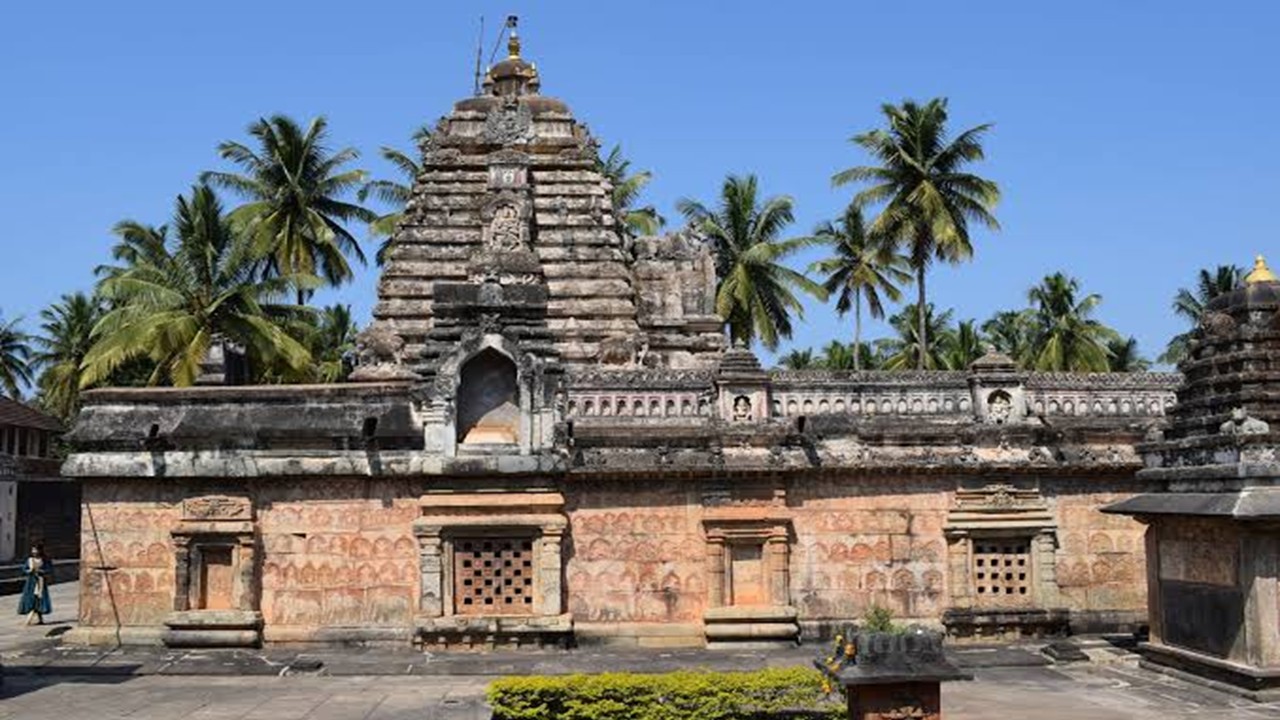
In the ancient town of Banavasi, amid the forests and river valleys of Karnataka’s Uttara Kannada district, stands the revered Sri Madhukeshwara Temple, one of the region’s most significant centres of Shaivite worship, dedicated to Bhagavan Shiva in the form of Madhukeshwara. Here, “Mahathobara” is an honorific title traditionally associated with an eminent and long-established temple.
Banavasi served as the capital of the Kadamba dynasty, one of the earliest native ruling families of Karnataka and among the first royal houses to promote Kannada in administration and public life. The Kadamba kingdom was established during the 4th century under Mayura Sharma, and Banavasi subsequently developed into an important centre of government, religion, trade, literature and learning.
The Kadamba Simhasana (Lion Throne) established here is a revered symbol of the Kadamba dynasty. Tradition holds that this stone throne was used during the coronation ceremonies of Kadamba kings, linking it directly to the royal and political history of ancient Banavasi, which served as the dynasty’s capital from the 4th century.
The town was known in earlier periods as Vanavasi or Vaijayanti. Its location near the Varada River and the forested landscape of the Western Ghats contributed to its religious and cultural importance. It is closely associated with Adikavi Pampa, the 10th century Kannada poet.
The temple underwent additions and alterations under later ruling powers, particularly the Kalyana Chalukyas and the Sonda rulers. Its sculptures and structural details also display Hoysala influence. This layered history makes the temple especially valuable. Instead of representing only one architectural period, it preserves elements of the Kadamba, Kalyana Chalukya and Hoysala traditions, allowing visitors to observe the changing styles of temple construction in Karnataka.
Sri Madhukeshwara
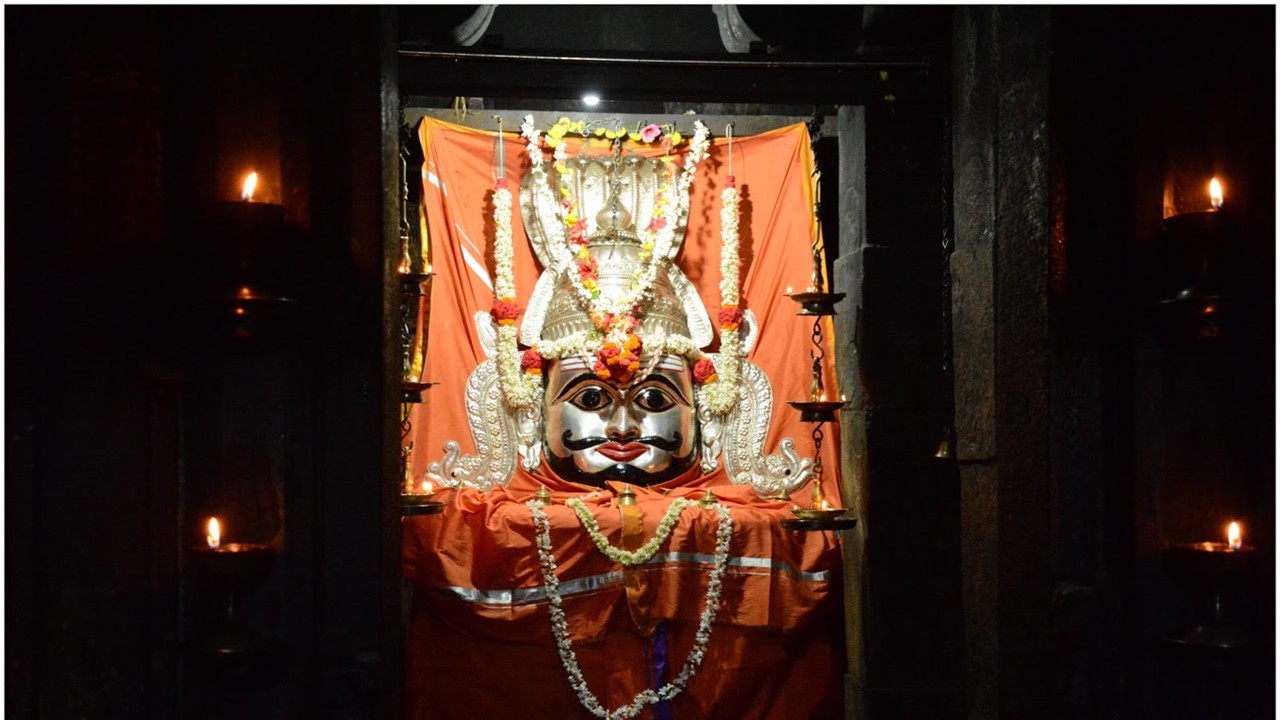
The name Madhukeshwara is traditionally associated with the unusual honey-like or golden-brown colour of the Shiva Linga worshipped in the sanctum. The word Madhu means “honey or bliss,” while Ishwara means “controller.” Madhukeshwara therefore is understood as “the controller associated with bliss” or “the honey-coloured controller.” Bhagavan Shiva is worshipped here as the presiding deity, and the Madhukeshwara Linga remains the spiritual centre of the temple.
According to local sacred tradition, the Madhukeshwara Linga is believed to have divine origins, and one popular account associates its establishment with Brahma, who is believed to have worshipped in the beginning. The linga’s honey-like colour is interpreted symbolically as representing the sweetness of divine grace.
The Varada River, which flows through the Banavasi region, is also treated with religious reverence. Its name is linked with Varada, meaning “giver of boons.” The river, forests and ancient shrines surrounding Banavasi help create the sacred landscape within which the tradition developed.
Another well-known local belief concerns a vertically divided image of Sri Ganesh Ji preserved in the temple complex. According to tradition, the other half of the image is in Varanasi. This belief symbolically connects Banavasi with one of India’s most important sacred centres of Shiva worship.
The temple also contains images associated with different Vedic traditions, demonstrating that the complex developed as more than a single-shrine institution. The presence of sculptures representing Shiva, Vishnu, Kartikeya, the Adityas and other deities reflects the inclusive character of medieval temple worship and artistic expression.
Architecture
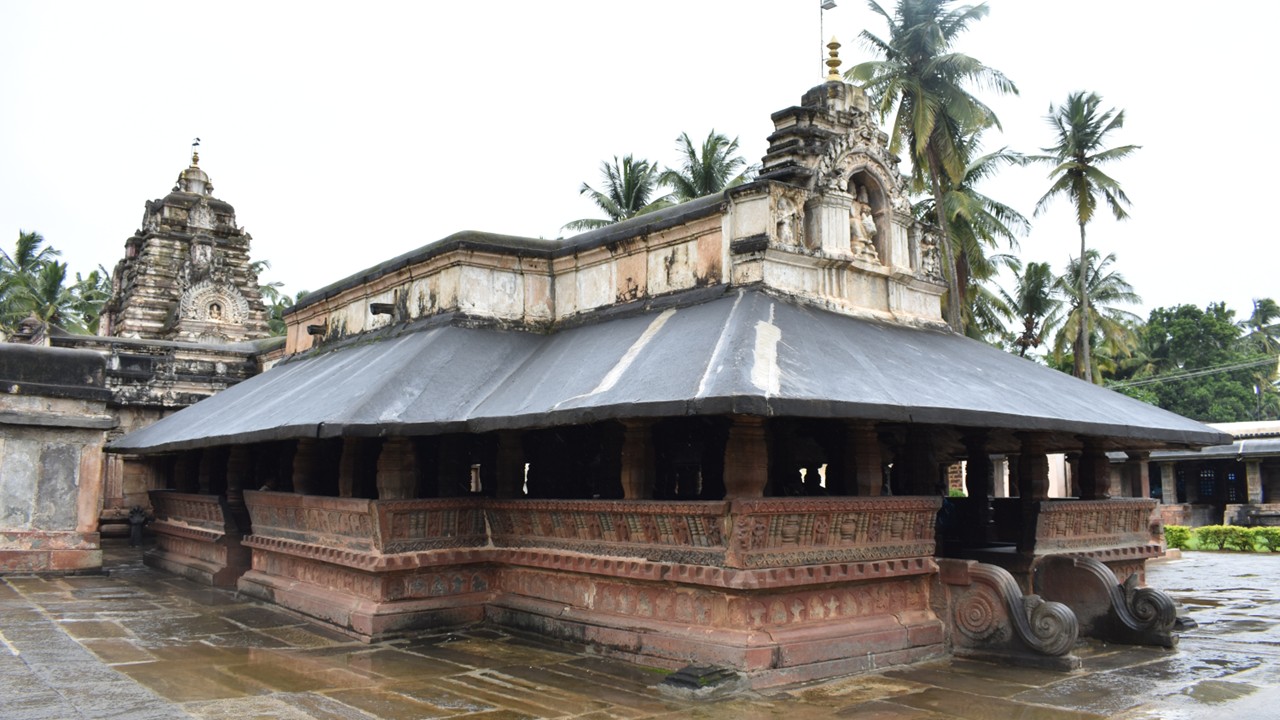
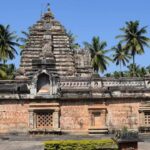
The Madhukeshwara Temple is constructed primarily in stone, and its design combines architectural features associated with the Kadambas, Kalyana Chalukyas and Hoysalas, making the temple an architectural record of Karnataka’s political and artistic history. Its principal components include the garbhagriha, or sanctum containing the Madhukeshwara Linga, and the Navaranga, the pillared hall situated before it. The Navaranga pillars have square cross-sections with rounded, cushion-like elements at the top, while the exterior parapet carries rows of relief carvings depicting divine figures, including the twelve Adityas, the Dikpalakas, or guardians of the directions, and the ten incarnations of Sri Vishnu. Important sculptures include images of Adi-Madhava and Kartikeya, which display Kadamba stylistic characteristics.
One of the temple’s most celebrated features is its large monolithic Nandi, the sacred bull and vehicle of Bhagavan Shiva. It is approximately seven feet tall and notes the traditional belief that it has been positioned so that one eye appears to look towards Shiva while the other looks towards Mata Parvati. The temple is also known for a finely worked stone cot, locally referred to as the Kallu Mancha as well as the Kadamba Simhasana. Its detailed execution demonstrates the stone-cutting and polishing abilities of medieval craftsmen.
Festivals
Maha Shivaratri is the temple’s principal religious festival, when devotees visit the shrine to worship Sri Madhukeshwara through special prayers, abhishekas, and devotional observances. Kadambotsava is an annual state-level cultural festival celebrating Banavasi’s Kadamba heritage through classical music and dance, folk performances, processions, drama, literary activities, crafts, books, handlooms, local cuisine, and heritage-related programmes. The festival is generally held over two days, often during the cooler months, but its exact dates and programme vary each year. The sacred month of Kartik is traditionally associated with lamp-lighting and special Shiva worship, while other important occasions include Mondays in the month of Shravan and locally observed temple celebrations; since the scale and schedule of these events may vary, current details should be confirmed directly with the temple authorities.
Darshan Timings of the Temple
The temple is open on all the days of the year between 6:00 AM to 1:00 PM and 4:00 PM to 8:00 PM.
Nearby Places to Visit
Sahasralinga: A unique sacred site on the banks of the Shalmala River, renowned for thousands of Shiva lingas carved on riverbed rocks.
Marikamba Temple, Sirsi: One of Karnataka’s most revered temples dedicated to Sri Marikamba, attracting devotees from across the state.
Yana Rocks and Caves: Famous for its towering black limestone rock formations and cave shrines dedicated to Bhagavan Shiva.
How to Reach Madhukeshwara Temple?
The best way to plan is through Tirtha Yatra’s Udupi Yatra Tour package. All the arrangements for your Yatra will be taken care of which you focus only on the spiritual experience of the journey.

By Road: Banavasi is about 23 to 24 km from Sirsi and is well connected by road. Regular buses and taxis are available from Sirsi.
By Train: The nearest railway stations are Sirsi, Talaguppa (approximately 55 km), Haveri (around 70 km), and Kumta (around 70 km). From these stations, visitors can reach the temple by local buses, taxis, or private cabs.
By Air: The nearest airports are Hubballi Airport, about 140 km away, and Belagavi Airport, about 180 km away. From either airport, travellers can continue their journey to the temple by road using buses, taxis, or cab services.
0
Leave a Reply