
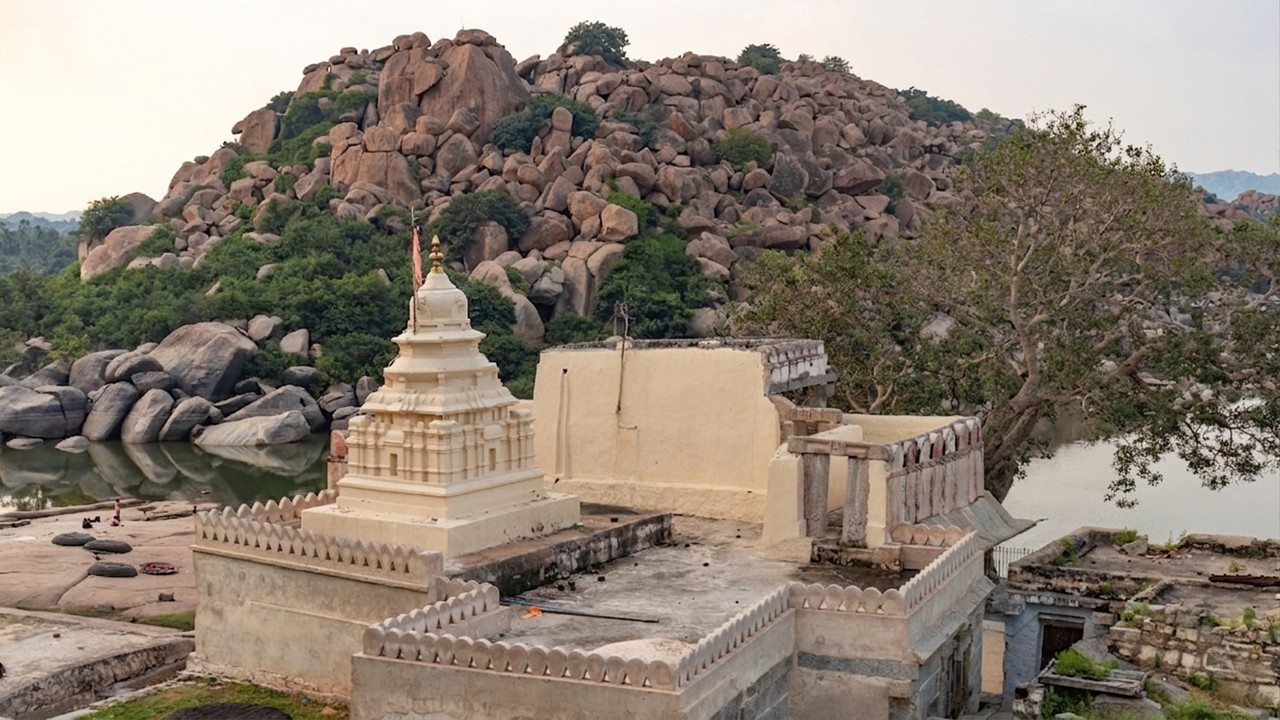
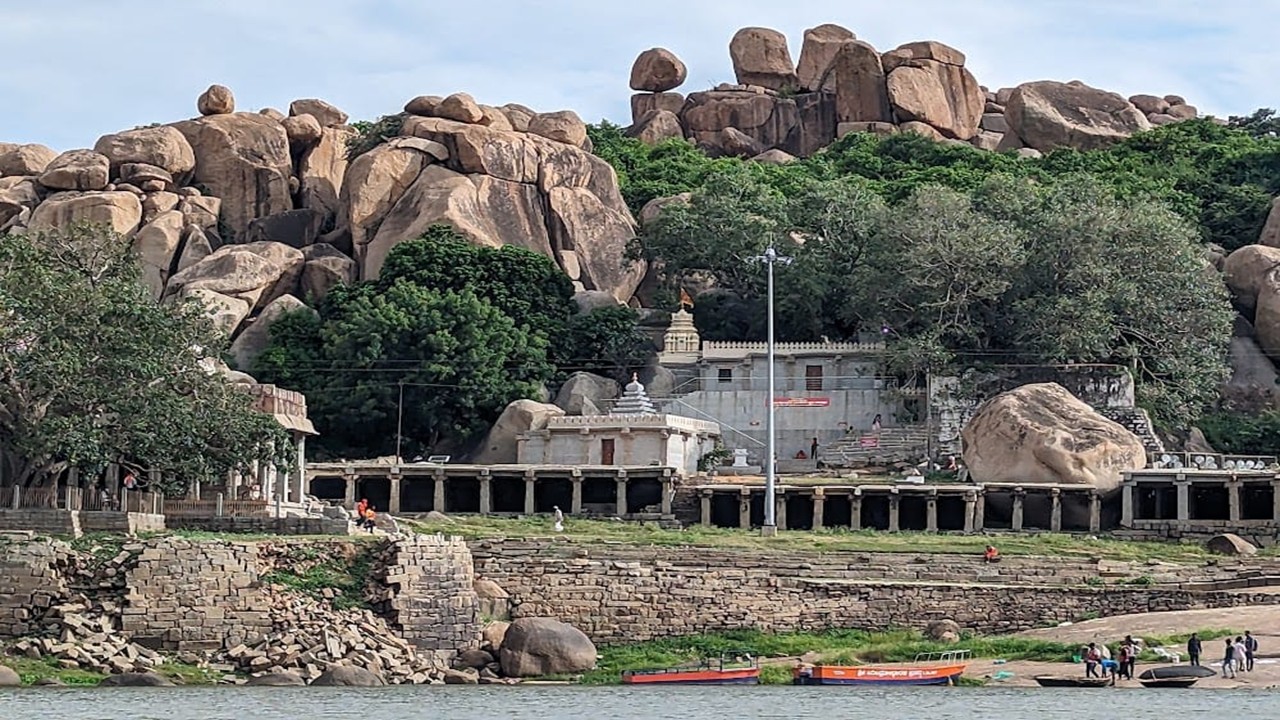
The temple is situated on the serene banks of the Tungabhadra River, attracting thousands of pilgrims and tourists from around the world alike.
According to the epic Ramayana, this is the exact spot where Lord Sri Rama met Lord Hanuman for the first time during the Vanavasa period while searching for Sita Devi.
Situated near Kodandarama Temple and just a 2 km walk from Virupaksha Temple, Yantrodharaka Hanuman Temple is the birthplace of the Sri Yantrodharaka
Hanuman Stotra, a sacred Sanskrit hymn composed by Vyasaraja during the reign of the Vijayanagara Empire. It is believed that those who recite these powerful verses regularly will have their wishes fulfilled.
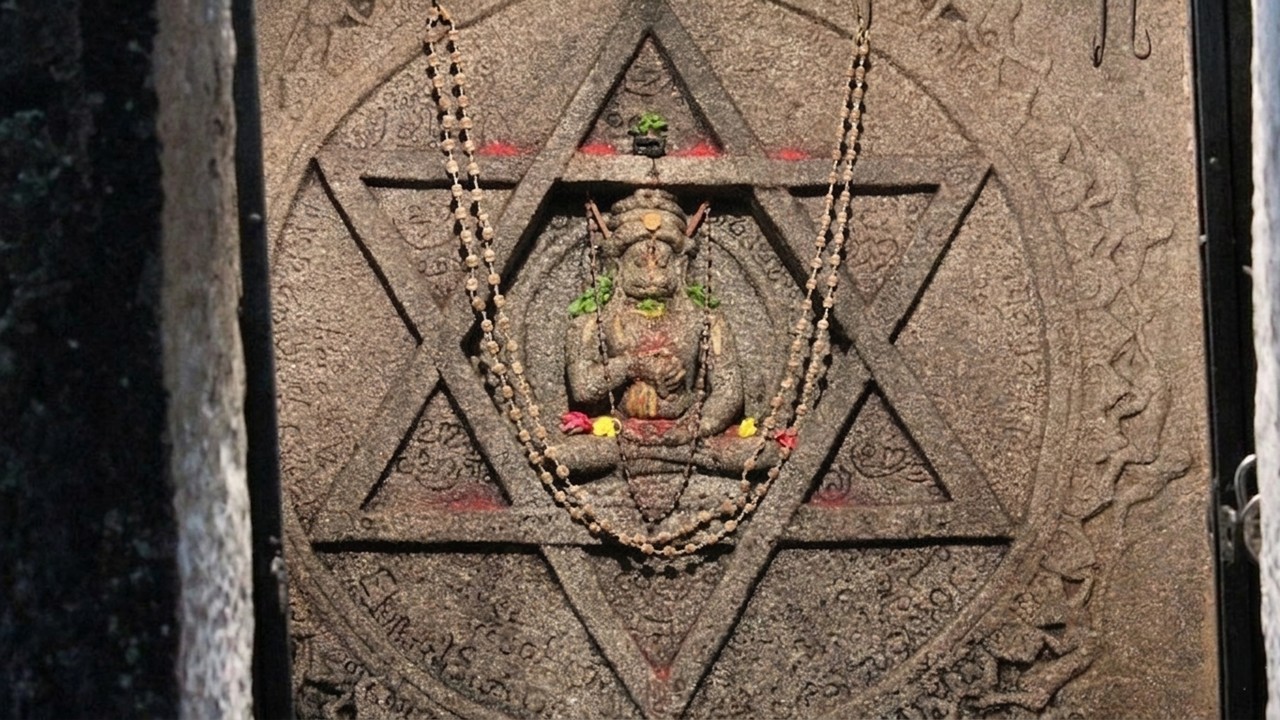
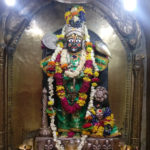
Deity of Lord Hanuman inside the Yantra
Lord Hanuman that is consecrated by Vyasaraja during the glorious rule of Vijayanagara empire, is seated in the centre of the powerful shatkona yantra – the yantra that has six corners.
There are twelve monkeys carved around the Yantra, with each monkey holding the tail of the next one, forming a continuous circle.
How Vyasaraja Bound Lord Hanuman Within the Sacred Yantra
Sri Vyasaraja would frequently visit a hill on the banks of the Tungabhadra River. Seated upon a rock, he would meditate upon Lord Hanuman with deep devotion.
While offering his prayers, he would draw the image of Lord Hanuman on the rock using charcoal. To his astonishment, a monkey would emerge from the drawing, leap and run around for a while, and then suddenly disappear. This miraculous event continued for twelve consecutive days.
Seeking an explanation, Sri Vyasaraja prayed fervently to Lord Hanuman. Pleased with his devotion, Lord Hanuman appeared in his dream and instructed him that, in order to bind and retain his divine presence, he should draw a sacred Yantra.
Acting upon this divine instruction, Sri Vyasaraja consecrated the deity of Lord Hanuman within a sacred hexagonal Yantra. Lord Hanuman was depicted in a serene meditative posture, while twelve monkeys stood guard around the Yantra, ensuring the deity’s eternal presence at the temple.
Benefits and Significance of Sri Yantrodharaka Hanuman Stotra
Sri Yantrodharaka Hanuman Stotra
Peenevritha Mahabaahum Sarva Shathru Nivaranam
Naanaaratna Samayukta kundaladi Virajitam
Sarvadaabheesta Dhataram Satham vy dridamahave
Vaasinam Chakratheerthasya Dakshinastham Girousadha
Thungaambhodi Tharangasya Vathena Parishobhithe
Naana Desha Gatheih Sadbhihi sevyamaanam Nripothamaihi
Dhoopa Deepadhi Neivedyaha Panchakaadhyascha Shakthithah
Bhajaami Sri Hanumantham Hemakaanthi Samaprabham
Vyasatheertha Yatheendranam Poojitham Pranidhanathaha
Thrivaaram Yah Patennithyam Sthothram Bhakthya Dwijothama
Vanchitham labathebhistam shanmasabyantharekalu
Putrarthi Labhathe Putra Yashorthi Labhathe Yashaha
Vidhyaarthi Labhathe Vidhyam Dhanaarhti Labhathe Dhanam
Sarvatha Maasthu Sandeho Harihi Sakshath Jagathpathihi
Yah Karothyathra Sandeham Sayathi Narakam Dhruvam
Ithi Sri Vyasaraja Theertha Virachitha Yanthroddharaka Hanumath Sthothram Sampoornam
Architecture of Sri Yantrodharaka Hanuman Temple
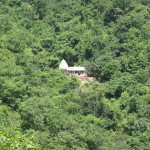
hill overlooking the Tungabhadra River.
Its elevated location, rock-cut shrine, natural boulder formations, and breathtaking views of Hampi’s sacred surroundings beautifully showcase the architectural brilliance of the Vijayanagara era, where devotion, nature, and stone craftsmanship were seamlessly brought together.
Timings of Sri Yantrodharaka Hanuman Temple
 Best Time to Visit
Nearby Places to Visit Around Sri Yantrodharaka Hanuman Temple
Tungabhadra River: This is a beautiful and scenic riverside spot, ideal for coracle rides, sunset views, and peaceful walks.
Kodanda Rama Temple: It is an ancient temple where Lord Rama is worshipped in his Kodanda form, holding a bow. Along with him, Lakshmana, Sita Devi, and Sugriva are also worshipped here. This sacred place where Lord Rama crowned Sugriva as the ruler of Kishkindha.
Achyutaraya Temple: It is a 16th-century Vijayanagara-era temple in Hampi, dedicated to Lord Tiruvengalanatha, showcasing exquisite architecture and intricate carvings.
How to Reach Sri Yantrodharaka Hanuman Temple
Hanuman at this divine pilgrimage destination. Climb the sacred steps, chant the powerful Yantrodharaka Hanuman Stotra, and immerse yourself in the spiritual vibrations of one of Hampi’s most revered temples.
By Air: The nearest airport is Jindal Vijaynagar Airport (Vidyanagar Airport), located about 33 km from the temple. From the airport, you can hire a taxi or use local transport to reach Hampi and the temple. Another major airport option is Kempegowda International Airport, Bengaluru, around 340 km away.
By Railway: The nearest railway station is Hosapete Junction (Hospet Railway Station), situated approximately 10–13 km from the temple. Regular trains connect Hospet with Bengaluru, Hyderabad, Hubballi, Goa, and other major cities. From the station, autos, taxis, and buses are available to Hampi.
By Road: The temple is well connected by road through Hampi. Regular KSRTC and private buses operate from Bengaluru, Hospet, Ballari, Hubballi, and nearby cities. Visitors can also drive directly to Hampi. The temple is located about 2 km from Virupaksha Temple and can be reached by autorickshaw or a short walk.


Leave a Reply