
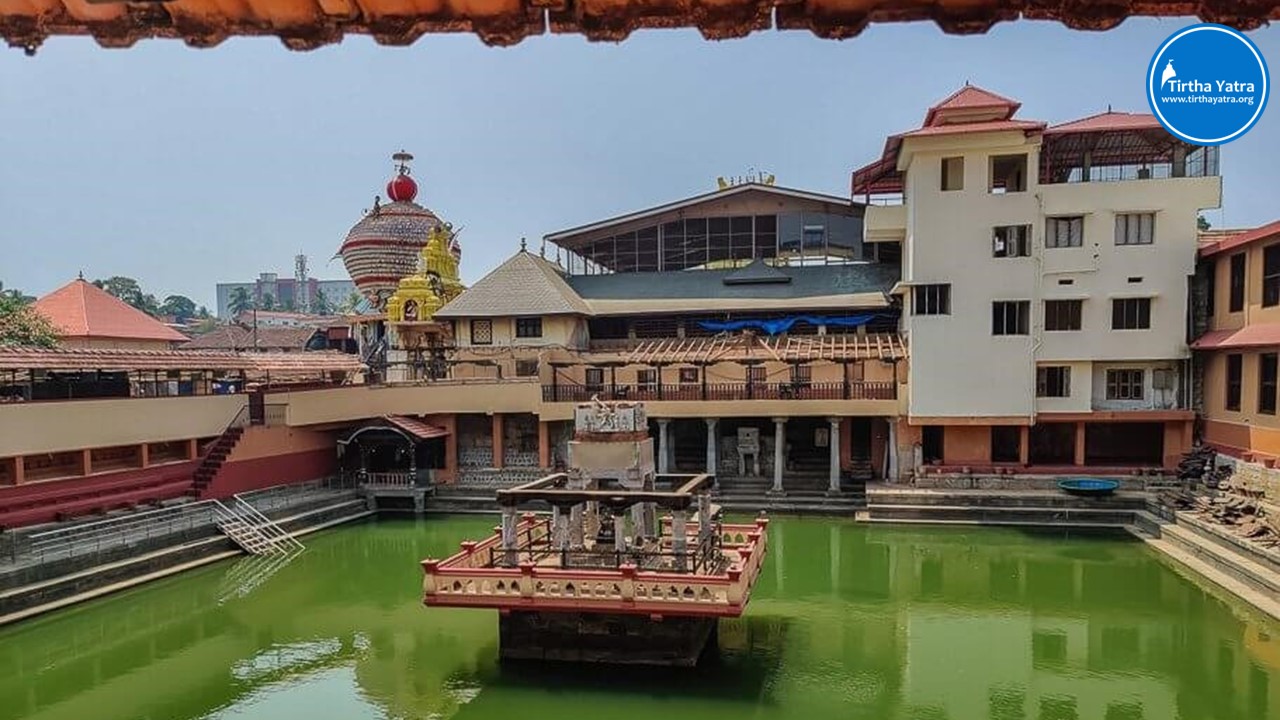
Udupi is a timeless, lush green, and scenic coastal city in Karnataka. Nestled between the foothills of Western Ghats to the east and the Arabian Sea to the west is a land of countless ancient temples steeped in traditions, sacred rituals, spiritual power, and heritage.
Udupi is regarded as the ethnic, religious capital of Karnataka, also known as Tuluva Nadu or Tulu Nadu. Tulu is the common communicative language, followed by Kannada and Konkani.
Commonly referred to as Parashurama Kshetra, this sacred region was created by Parashurama, a divine incarnation of Lord Vishnu. He created this Divya Bhumi by taking a part of the land from the sea.
Parashurama’s disciple, King Rama Bhoja, performed an Ashvamedha Yagna at this site. Later, Parashurama instructed his disciple to build a city centered around a Rajatha Peetha. He installed Parashurama in the form of Anantheshwara—Vishnu worshiped as a Linga. King Rama Bhoja also founded four distinct Naga temples and four Durga temples around the sacred site.
This holy land has a strong connection with Lord Sri Krishna; therefore, nicknamed as “Mathura of the South”. There is a famous Sri Krishna temple which was established by revered saint Purna Prajna, also known as Madhvacharya, who was the founder of Dvaita philosophy.
Udupi is very famous for its beautiful pristine beaches, delicious cuisines, Udupi hotels, serene greenery, colorful festivals, financial institutions, traditional sports, cultural ceremonies, and much more.
Vedic History of Udupi
Vedic history links Udupi with the Chandramouleeshwara Temple. In Sanskrit, the word “Udupi” is a combination of “Udu” (stars) and “Pa” (lord), meaning “Lord of the Stars.”
According to a Puranic scene, Lord Chandra was cursed by his father-in-law, King Daksha, which caused the moon’s light to diminish. To lift this curse, Chandra prayed to Lord Shiva on the banks of Chandra Pushkarini. Impressed by Indra’s devotion, Lord Shiva restored the moon’s shine.
To show gratitude to Lord Shiva, Indra built Chandramouleeshwara temple in Udupi. Hence, Udupi got its name as ‘Lord of stars’, the moon.
Traditional Art Forms of Udupi
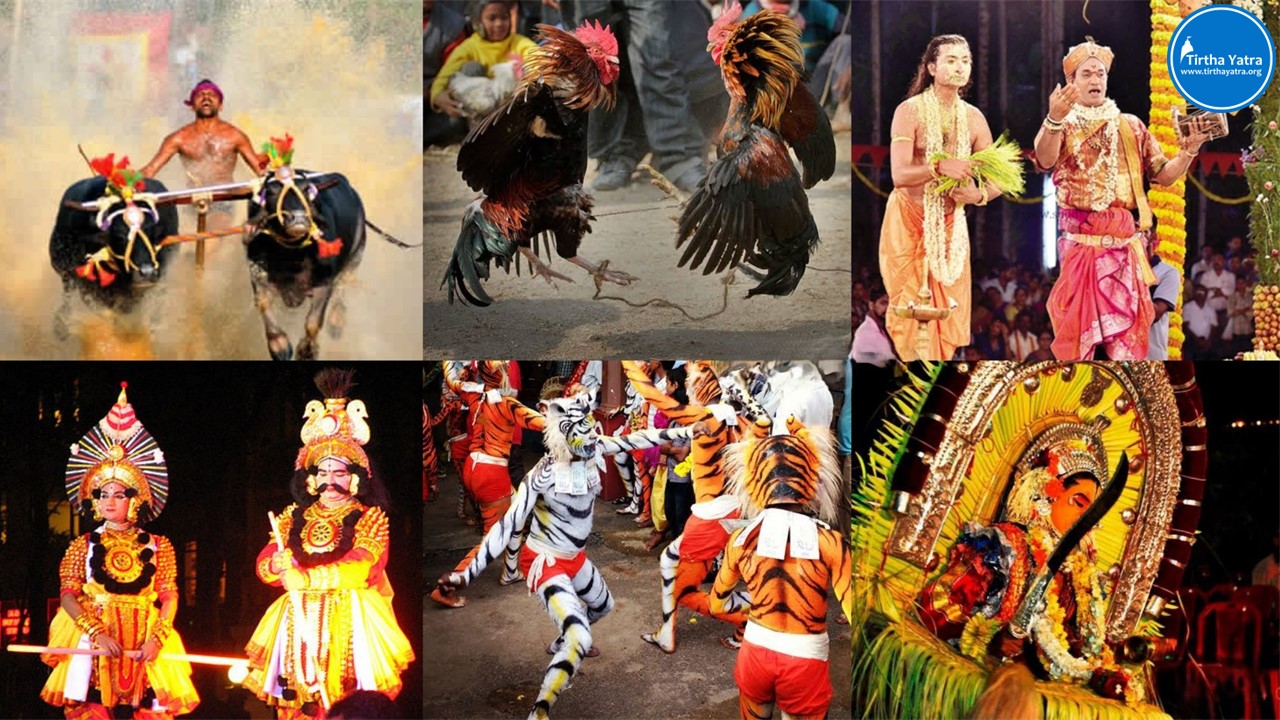
Yakshagana: This traditional art-play was started by the disciples of Madhvacharya to depict the stories of Ramayana and Mahabharata to the general public, who could not study the scriptures directly. It is performed by an artist depicting the stories from the Ramayana and Mahabharata. The artist performs the dance by narrating the story in a dramatic way with the music playing behind. They are decorated with heavy costumes. The Performance is carried out throughout the night.
Bhuta Kola/Bhuta Aradhane: It is a kind of worship practised among the Tulu community to invoke spirits, seek blessings, and find solutions to their problems.
Peli Yesa/Huli Vesha/Tiger dance: It is a traditional folk dance performed by young men on the streets on the occasions of festivals like Ashtami Rohini, Navaratri, and Ganesha Chaturdashi. The boys who perform this dance paint their bodies like the stripes of the tiger and dance energetically according to drum beats, perform acrobatics, stuns entertaining people viewing it.
Traditional Sports of Udupi
There are many traditional sports that are being practiced even today.
Kambala: This is a famous local sport carried out by farmers to thank the gods for protecting them from ailments. The farmers race their buffalo with whips or ropes in flooded paddy fields. It is held in the months of March and November.
Tappangayi: This game is called “village rugby”, where players throw the ball top and snatch a coconut from others who are holding it. This requires great physical stamina.
Tonka: This is a traditional game played during the fairs and festivals. The players play while jumping on one leg while catching the others who are running in the specified area.
Kutti Donne: This traditional game is popularly called as gilli danda, involves two teams. The bigger stick known as danda hits the smaller stick called gilli with great force in the air.
Berchendu: Also called Pilchandi, the players try to hit the other person with a ball, while the other person tries to dodge it.
Udupi Cuisines
Udupi is famous for spicy, delicious dishes. Crispy Masala Dosa, neer dosa, uppu huli kara dosa, paper dosa, rave dosa, benne dosa, soft idli, with familiar coconut chutney and sambar. All the items are served hot.
One should never miss the strong, rich flavor of filter coffee, which is served in a small cup. Also, Buns or Mangalore buns are made from maida and banana.
Kadubu/Kotte Kadubu: It is a traditional dish, prepared by pouring idli batter into cups crafted from jackfruit leaves. As Kadubu is steamed, it imparts a sweet aroma.
Moode: It is popularly called as Kadubu, cylindrical idlis, steamed in aromatic jackfruit or banana leaves. It is a must-try dish if you visit Udupi.
Pathrode: It is a cherished Konkani delicacy, of spicy rice-coconut batter spread onto Colocasia leaves, rolled into pinwheels, and steamed to perfection.
Goli Bajji: It is also called Mangalore bajji, Goli Bajji. It is made from a fermented batter of flour, curd, spices, and herbs.
Festivals of Udupi
Paryaya Festival: It is celebrated fourth day after Makar Sankranti, marking the ceremonial handover of worship and administrative duties of Sri Krishna Matha from one of the eight Ashta Mathas to the next.
Naga Aradhana: It is a deeply spiritual, all-night ceremony held between December and April, during which an intricate serpent mandala is drawn and two priests—Nagapatri (male snake) and Naga Kannika (snake maiden)—perform symbolic dances around it to invoke serpent deities and bless participants.
Naga Mandala: It is a vibrant, serpent-worship ritual traditionally held between December and April in Dakshina Kannada and Udupi districts. During the ceremony, two performers—one embodying the male snake (Nagapatri) and the other the snake maiden (Naga Kannika)—dance through the night around an elaborate, naturally colored serpent mandala to represent the divine union of cobras.
Makara Sankranti: It is the major harvest festival celebrated among the people of Udupi, where a traditional dish “tilgul” is prepared. People also celebrate by flying colorful beautifully decorated kites. It is celebrated for 8 days.
Navaratri: Nine-day festival celebrated in honor of Durga Devi and worshiped in nine forms. Special prayers are offered to god. Temple conducts many cultural events like classical dance, music, instrumental music, etc.
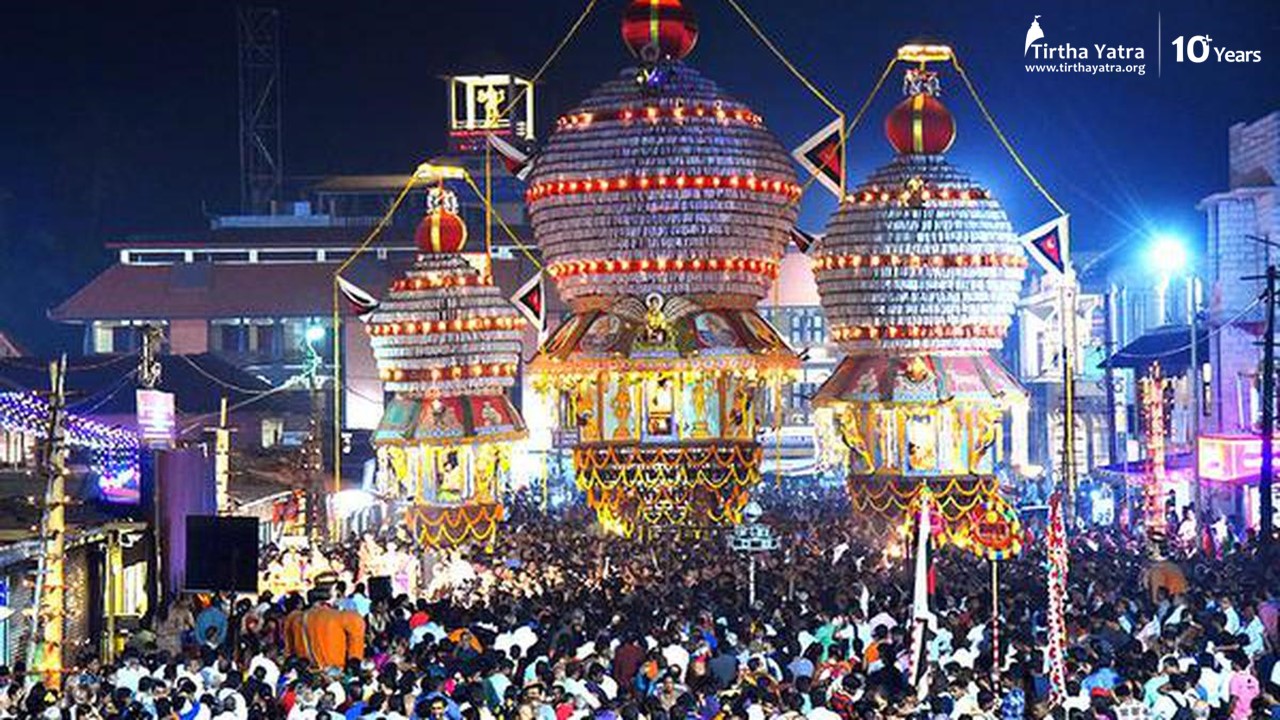
Krishna Janmashtami: It is the most celebrated festival for the people of Udupi. Celebrated as Ashtami-Rohini. This day is marked as the birthday of Lord Sri Krishna.
The city appears very grand on this day.
Best Time to Visit Udupi
Famous Temples in Udupi
Astha Mathas in Udupi: These are the eight Mathas in Udupi, founded by Madhvacharya. The eight mathas are Palimaru, Adamaru, Krishnapura, Puttige, Shirur, Sodhe, Kaniyoor, and Pejavare.
Chandramouleshwara Temple: This is the oldest temple in Udupi. This temple was constructed by Lord Indra for Lord Shiva, in gratitude for removing his curse. Just located beside the famous Sri Krishna temple. It must be visited before visiting the Sri Krishna temple.
Anantheshwara Temple: Located in Shivalli village, this temple is 1000 years old. Lord Shiva is worshiped here. The Brahmins in this village is known as Shivalli Brahmins.
Siddhi Vinayaka Temple: Located in Annegudda, this temple is dedicated to Lord Vinayaka. This place is also known as Kumbhasi.
How to Reach Udupi?
Have you visited Udupi or are you planning a visit soon? Then consider taking Tirtha Yatra’s Udupi Yatra. All arrangements are well taken care of.

If you wish to travel on your own, here are a few options.
By Air: Mangalore International Airport is the nearest airport to the city of Udupi. From Mangalore to Udupi, it takes approximately 1 hour. From here, you can travel by taxi or bus. If you prefer a taxi, it is very expensive.
By Rail: Udupi Junction is the nearest railway station. From here, taxis, cabs, and autos can be hired to explore the city of Udupi.
By Road: The city of Udupi is well connected by road network. The roads are connected to major cities like Mangalore, Bangalore, Chennai, Delhi, Kolkata, etc. You can enjoy the local sightseeing by hiring a taxi, cab, or auto. You can also travel using government transport buses.
Leave a Reply