
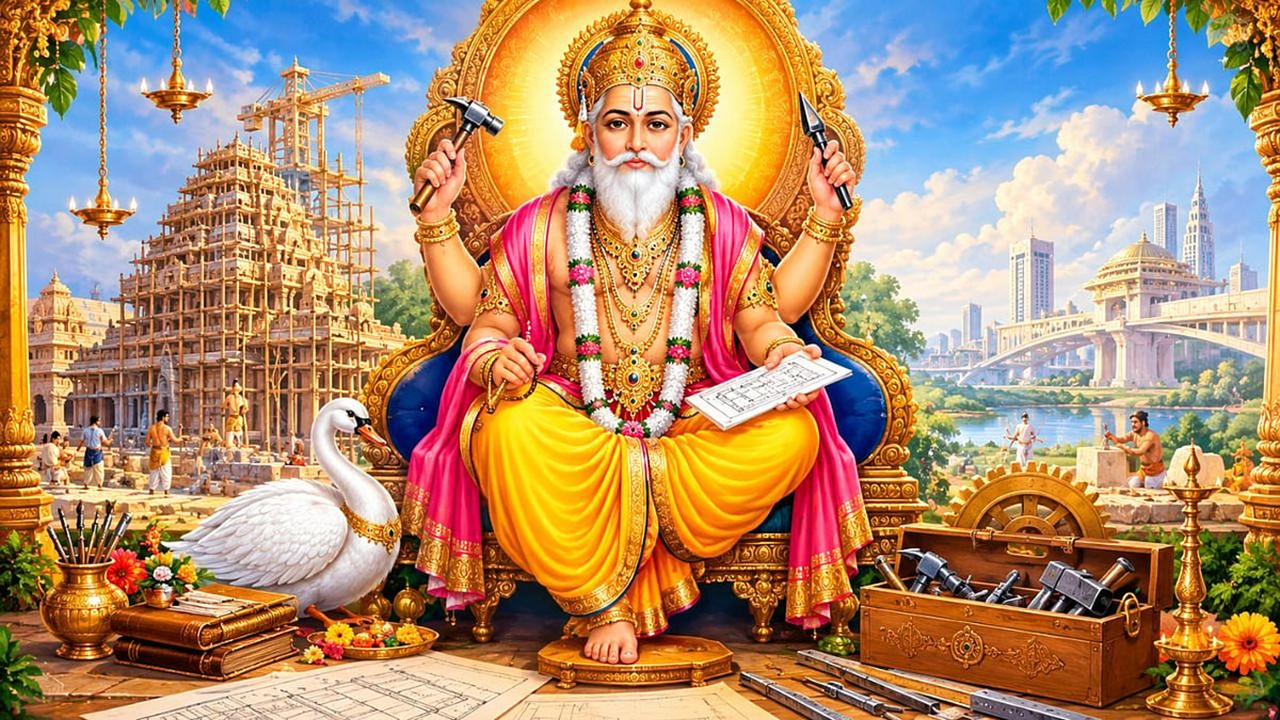
From dazzling celestial cities and golden palaces to extraordinary weapons and sacred images, Vishwakarma occupies a unique place in Sanatana Dharma as the architect and craftsman of the Devas. His creations are described as expressions of divine knowledge, extraordinary skill and unmatched craftsmanship.
Vishwakarma – Divine Architect
Unlike an ordinary architect, Vishwakarma has created structures for the Devas and other divine beings according to cosmic principles.
His creations are often described as possessing extraordinary beauty, precision and splendour. His divine craftsmanship is also associated with weapons, ornaments, chariots and other objects used by the Devas.
For this reason, Vishwakarma is worshipped by artisans, architects, engineers, craftsmen and workers who regard skill and craftsmanship as sacred gifts.
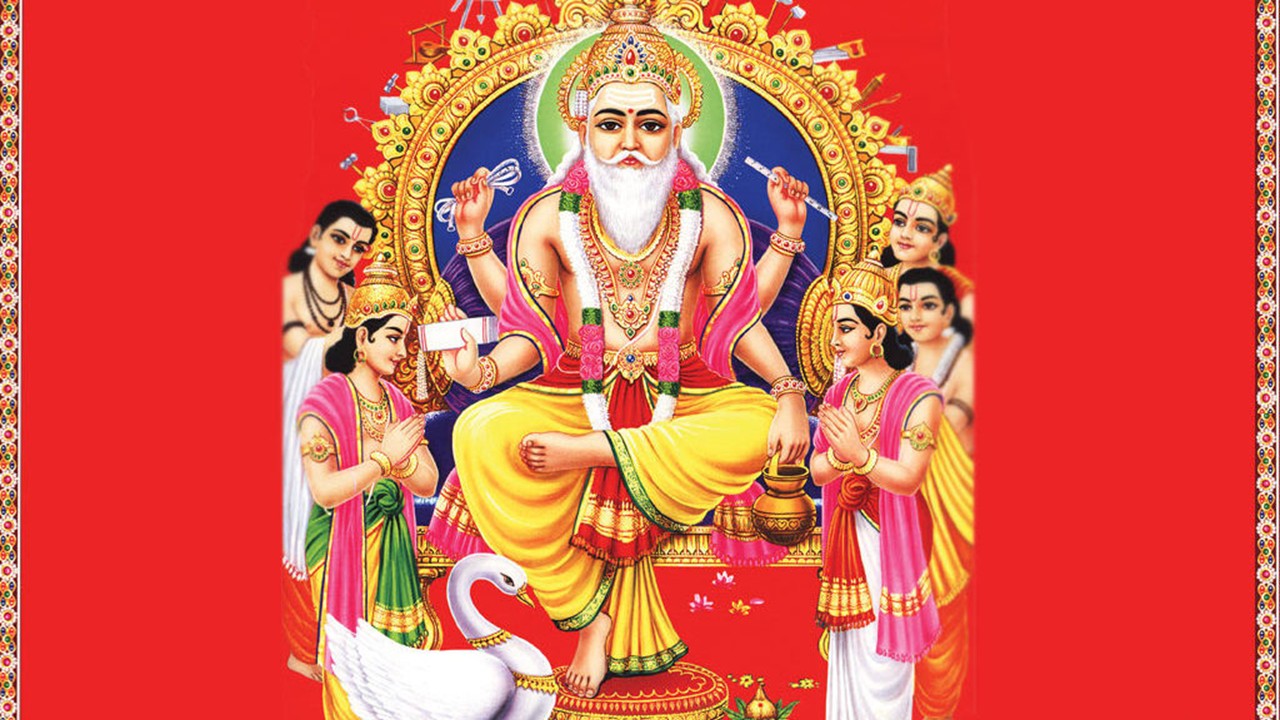
Traditional Dhyanam of Vishwakarma
कोटिसूर्यप्रतीकाशं सर्वजीवदयापरम्॥
देवदेवं महादेवं विश्वकर्म जगद्गुरुम्।
प्रसन्नवदनं ध्यायेत्सर्वविघ्नोपशान्तये॥
This traditional verse invokes Vishwakarma as a divine and benevolent master of craftsmanship and as Jagadguru, the teacher of the world.
Temples Traditionally Attributed to Vishwakarma
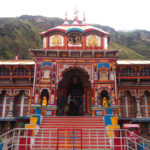
According to local tradition surrounding the Baba Baidyanath Temple in Deoghar, Jharkhand, Vishwakarma have built five important sacred structure within the temple complex in a single night. Vishwakarma while traveling through the sky in the Pushpaka Vimana, his celestial hammer fell at Deoghar. Upon encountering the sacred Jyotirlinga of Lord
Shiva, established by demon king Ravana, Vishwakarma decided to construct a group of divine temples at the site.
Vishwakarma
began by building the main Shiva temple. He then went on to construct temples for Goddess Parvati, Lord Ganesha, and the Sandhya Temple. His final task was to build a temple dedicated to himself, completing the set of five temples before the night came to an end.Gola Math Temple, Maihar
Gola Math Temple in Maihar is an excellent craftmanship of Vishwakarma, built overnight. It is so unbelievable that stones are joined together and meticulously carved that the temples architecture looks astonishing.
Pashupatinath Temple, Kathmandu
Pashupatinath Temple in Kathmandu, Nepal, is connected with Vishwakarma in some traditional accounts concerning its sacred origins and construction. Dedicated to Lord Pashupatinath (Shiva), it is one of the most important Shaivite pilgrimage sites in the world.
Kadri Manjunath Temple, Mangaluru
According to traditional accounts, the Kadri Manjunath Temple in Mangaluru was established by Parashurama after he reclaimed the land from the sea. Bhagvan Shiva appeared at the sacred Rasakoopa well in Kadalivana (present-day Kadri) and instructed Parashurama to build a temple.
Following Shiva’s command, Parashurama is said to have sought the help of Vishwakarma, the celestial architect. Vishwakarma then designed and constructed the temple and the settlement surrounding it.
Athi Varadar / Athi Varadar Temple, Kanchipuram
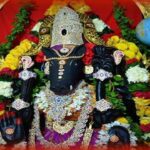
Once Brahma performed Ashwamedha Yajna in the Kanchipuram region. As part of the sacred preparations, Brahma sought the help of Vishwakarma, the divine architect, to carve the principal Deity of Athi Varadar, using the wood of an athi tree, a type of fig tree.
Narasimhapalli, Mayapur
Narasimhapalli, also known as Devapalli, is a sacred site in Navadvipa Dhama, West Bengal. According to Sri Navadvipa Dhama Mahatmya, Lord Narasimha visited the area after defeating Hiranyakashipu and rested by the Mandakini River. Attracted by His presence, the demigods, led by Brahma, settled there to serve Him. Vishwakarma, the celestial architect, is said to have built thousands of magnificent stone and jewel-studded residences for them. Though these structures have disappeared over time, the surviving tilas such as Brahma-tila, Indra-tila, and Ganesha-tila are traditionally believed to mark their locations.
Deities and Divine Forms Crafted by Vishwakarma
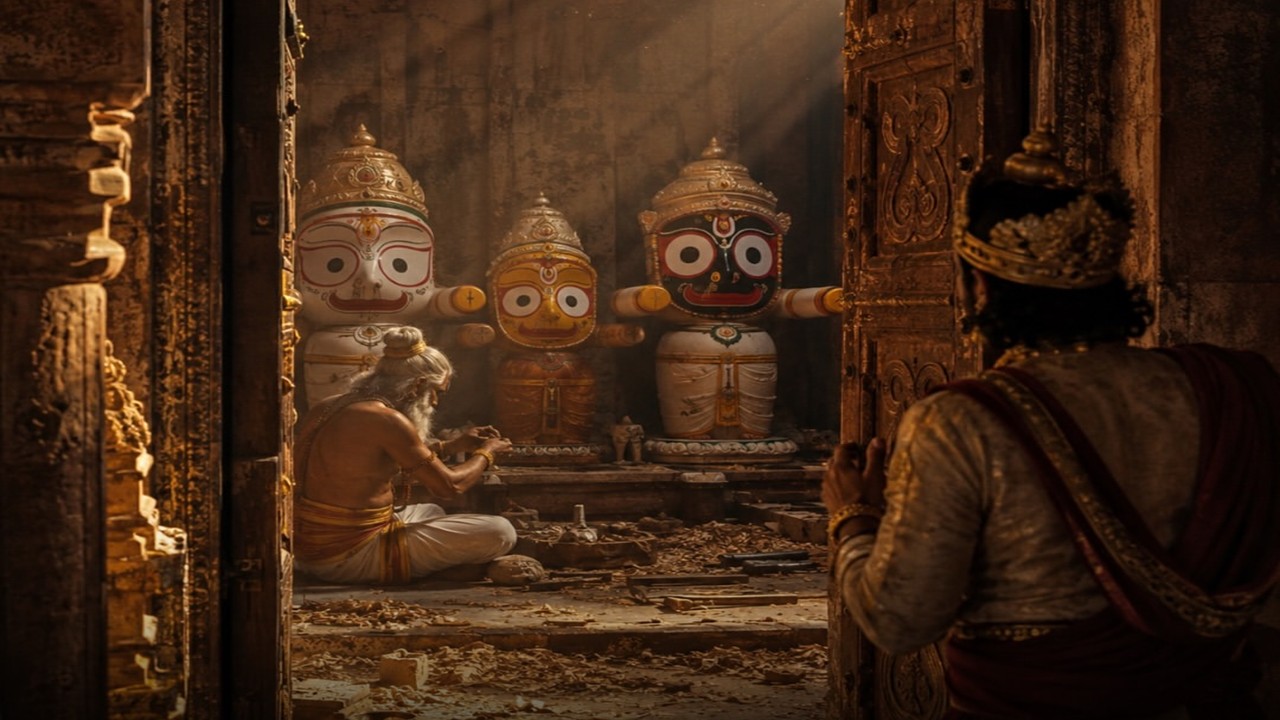
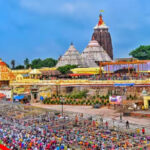
Jagannath, Balabhadra and Subhadra: In the famous Jagannath tradition, Vishwakarma appears as an old carpenter and carves the divine Deities.
Suryadev (Surya): According to the Vishnu Purana and Samba Purana traditions, Vishwakarma reduced Surya’s excessive radiance, making his form bearable, and used
the removed radiance to create divine weapons.
Udupi Sri Krishna: The divine Deity of Udupi Sri Krishna was crafted by Vishwakarma, who was worshiped in Dvaraka.
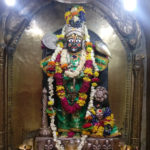
Guruvayurappan: According to tradition, the Deity of Guruvayur Sri Krishna was created by Vishwakarma and worshipped by Brahma and later by other divine figures before reaching Guruvayur.
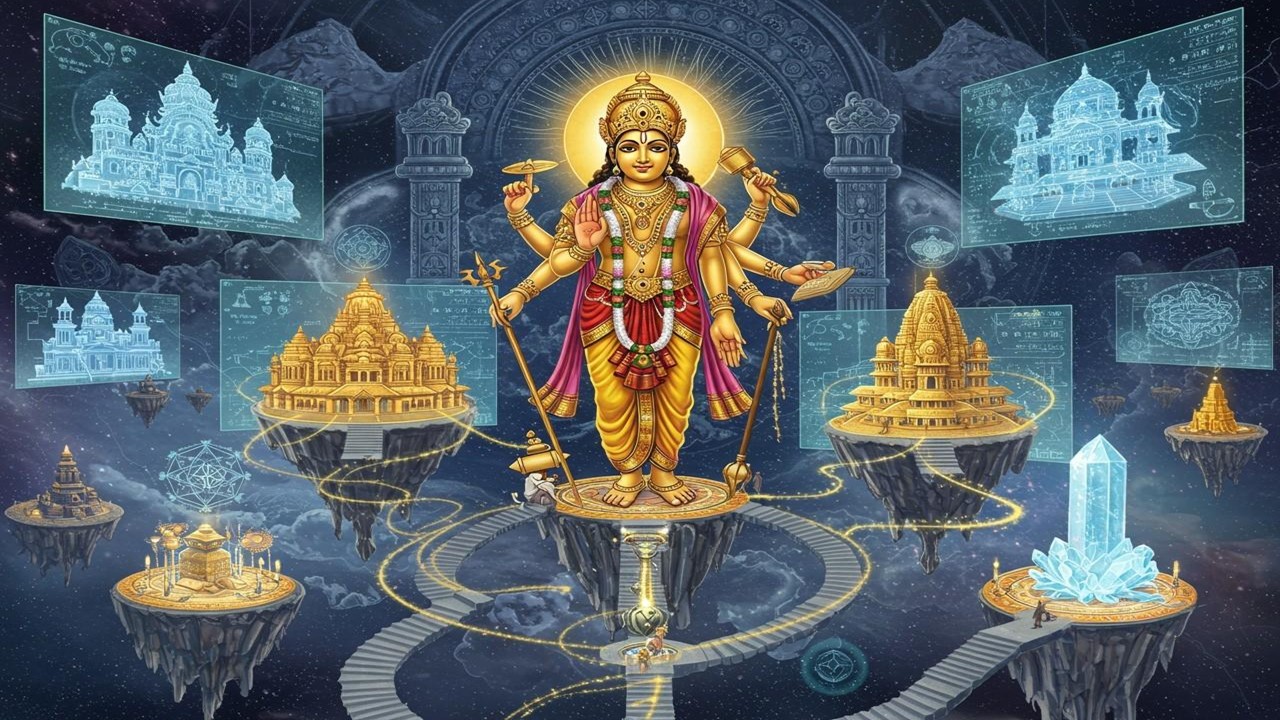
Vishwakarma: Divine Architect of Cities, Weapons & Vimanas
- Cities: He is traditionally associated with the creation of Lanka, Indraprastha, Dwarka, and Amaravati, celebrated for their extraordinary beauty and architecture.
- Ayudhas: Vishwakarma is credited with crafting powerful divine weapons, most famously Indra’s Vajra, made from the sage Dadhichi’s bones.
- Vimanas: He is traditionally associated with the Pushpaka Vimana, a magnificent flying celestial vehicle described in the Ramayana.
- Divine works: He also created palaces, ornaments, chariots, and other celestial implements for the gods.
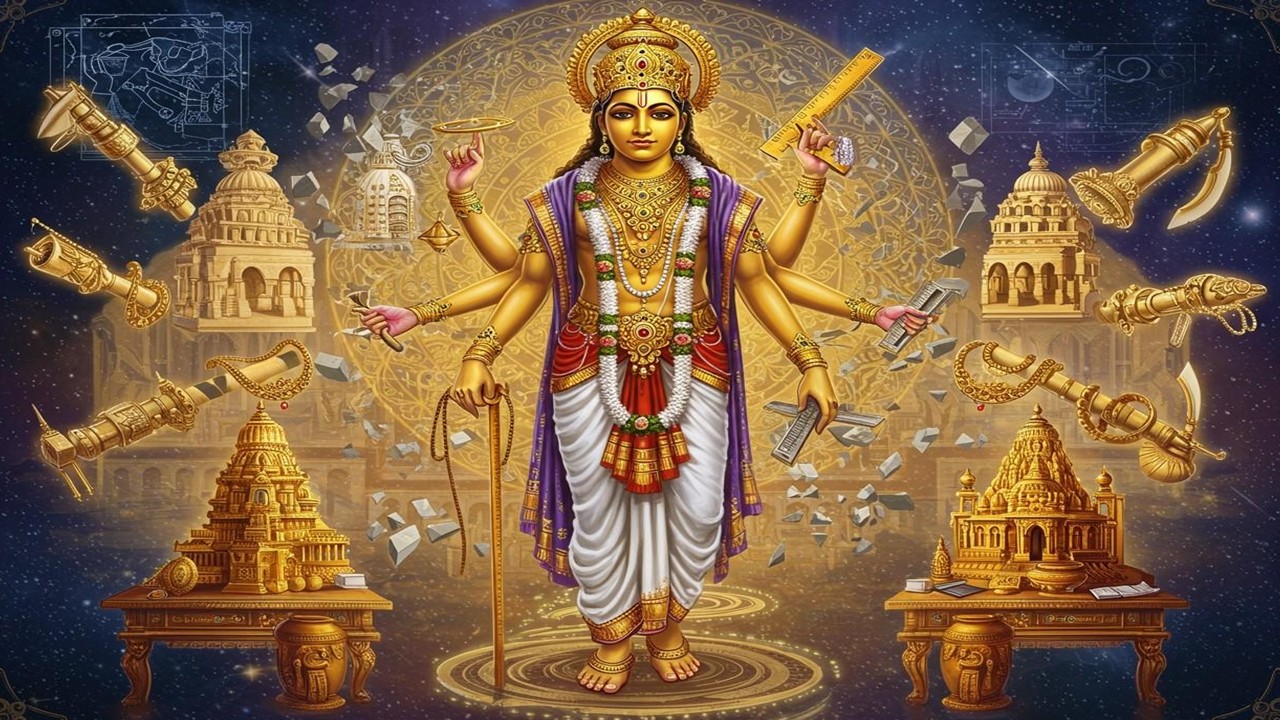
Vishwakarma and Temple Architecture
Indian temple architecture developed through highly sophisticated systems of measurement, proportion, orientation and construction. Texts on Vastu Shastra and Shilpa Shastra preserve extensive knowledge concerning architecture, sculpture and sacred construction.
Vishwakarma
represents the divine ideal behind this tradition.A temple was not simply regarded as a building. It was conceived as a sacred space where architecture, sculpture, geometry, ritual and spirituality came together.
The sanctum, temple tower, gateways, pillars and sculptures were all given symbolic significance.


Leave a Reply