
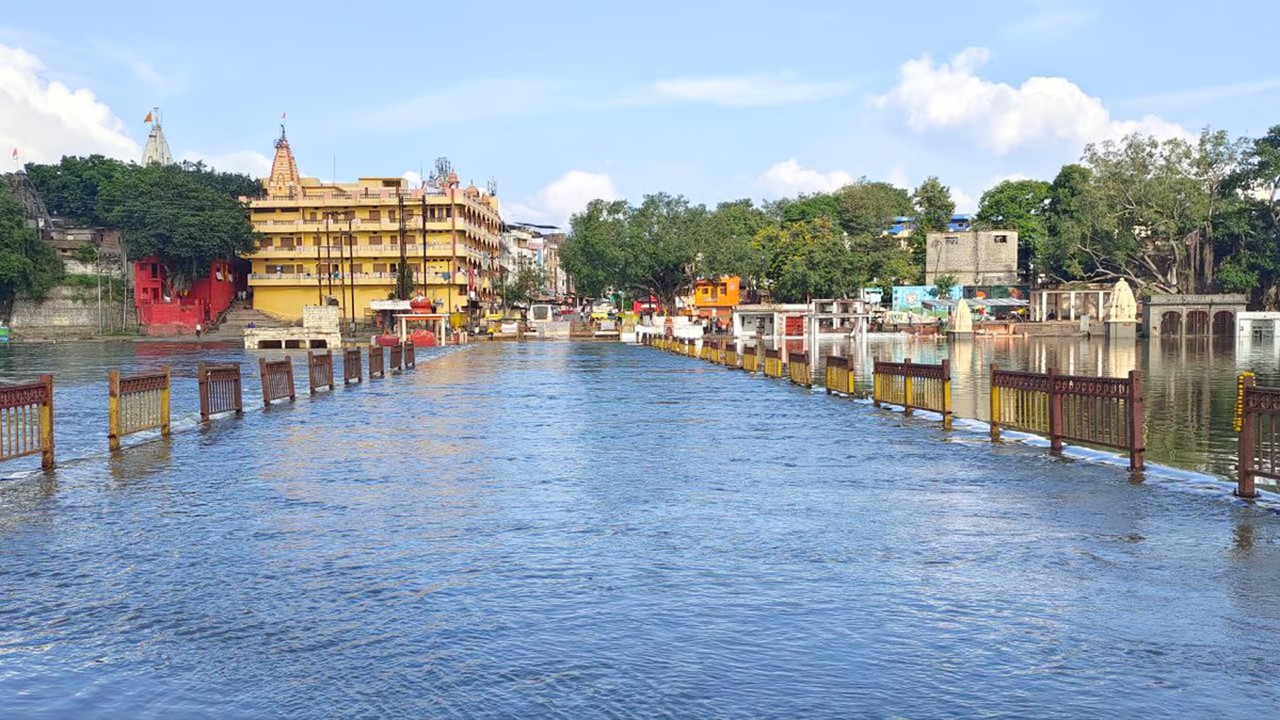
Shipra River, also known as Kshipra, is one of the most sacred rivers of Northern Bharat and the spiritual lifeline for the city of Ujjain. It originates from the Kakri Bardi (Kakri-Tekdi) Hills in the Vindhya Range near Indore in Madhya Pradesh. From its source in the Malwa region, the river flows generally northward across the Malwa Plateau, covering about 195 kilometres.
Shipra River occupies a special place among the many sacred rivers praised in the Puranas. Flowing through the sacred city of Ujjain, it is celebrated in the Avanthi Khanda of the Skanda Purana as a divine river capable of destroying sins, removing suffering, sanctifying ancestors, and granting liberation. Several chapters of the Avanti Kshetra Mahatmya are dedicated entirely to its glory, uncovering the river’s role in the spiritual landscape of the Avanti kshetra.
Unlike many rivers that flow eastward toward the Bay of Bengal, this Shipra River follows in northern direction entirely within the state of Madhya Pradesh. Along its journey, it passes through several important districts, including Indore, Dewas, Ujjain, Ratlam, and Mandsaur. However, it is most closely associated with the sacred city of Ujjain, one of the seven sacred cities (Sapta Moksha Puri Sthalams) in the Sanatana tradition.
Several tributaries join with the flow of the Shipra River. The most important among them are the Khana River, which joins from the left bank after flowing through the Indore region, and the Gambhira River, which joins from the right bank near Ujjain. A small seasonal stream known as Chhoti Shipra (also called as Kshepra) also joins the river during the monsoon months.
After flowing northward through the central regions of the Malwa region, the Shipra River eventually merges with the Chambal River near the Madhya Pradesh-Rajasthan border, called as the Mandsaur. The Chambal itself is a major tributary of the Yamuna River, which ultimately joins the Ganga. Thus, the Shipra River forms a part of the greater Ganga river system in the Norther Bharat.
Sthala Purana of Shipra River
Shipra River is not merely as a terrestrial river but a celestial stream that manifests in different realms under different names in all the three worlds. As described in the Skanda Purana, in a dialogue between Veda Vyasa and Sanatkumara, the sage glorifies her greatness as follows:
नास्ति शिप्रासमा नदी पृथिव्यां मुनिसत्तम । यस्यास्तीरे नरः स्नात्वा सद्यो मुक्तिमवाप्नुयात् ॥
वैकुण्ठे सा समुत्पन्ना शिप्रा नाम सरिद्वरा । स्वर्गे ज्वरघ्नी विख्याता महाद्वारे पापघ्निका ॥
पातालेऽमृतसम्भूता वाराहे विष्णुदेहिका । अवन्त्यां कामधेनोश्च सम्भूता शिप्रा विश्रुता ॥
Meaning: “O foremost sage, there is no river on Earth equal to Shipra. One who bathes on her banks attains liberation. In Vaikuntha she is known as Shipra; in heaven as Jvaraghni, the destroyer of fever; at Mahadvara as Papaghnika, the destroyer of sin; in Patala Loka as Amritasambhava; in the Varaha Kalpa as Vishnudeha and in Avanti, she is renowned as the Shipra River born from Kamadhenu.”
According to Skanda Purana, as Kamadhenu served the devatas and sages, a celestial stream issued forth from her divine essence and manifested on Earth as the Shipra River. Because she originated from Kamadhenu, Shipra came to be regarded as a river of inexhaustible merit, capable of nourishing the body, purifying the mind, and uplifting the soul.
Another historic tradition associates the river with Sri Vishnu and his incarnations. Shipra is also called as Vishnudeha since she emerged from the heart of Varaha, the boar incarnation of Sri Vishnu. On her banks stands the famous Sandipani Ashrama, where Sri Krishna, Balarama, and Sudama are believed to have received their education from Guru Sandipani in Dwapara Yuga.
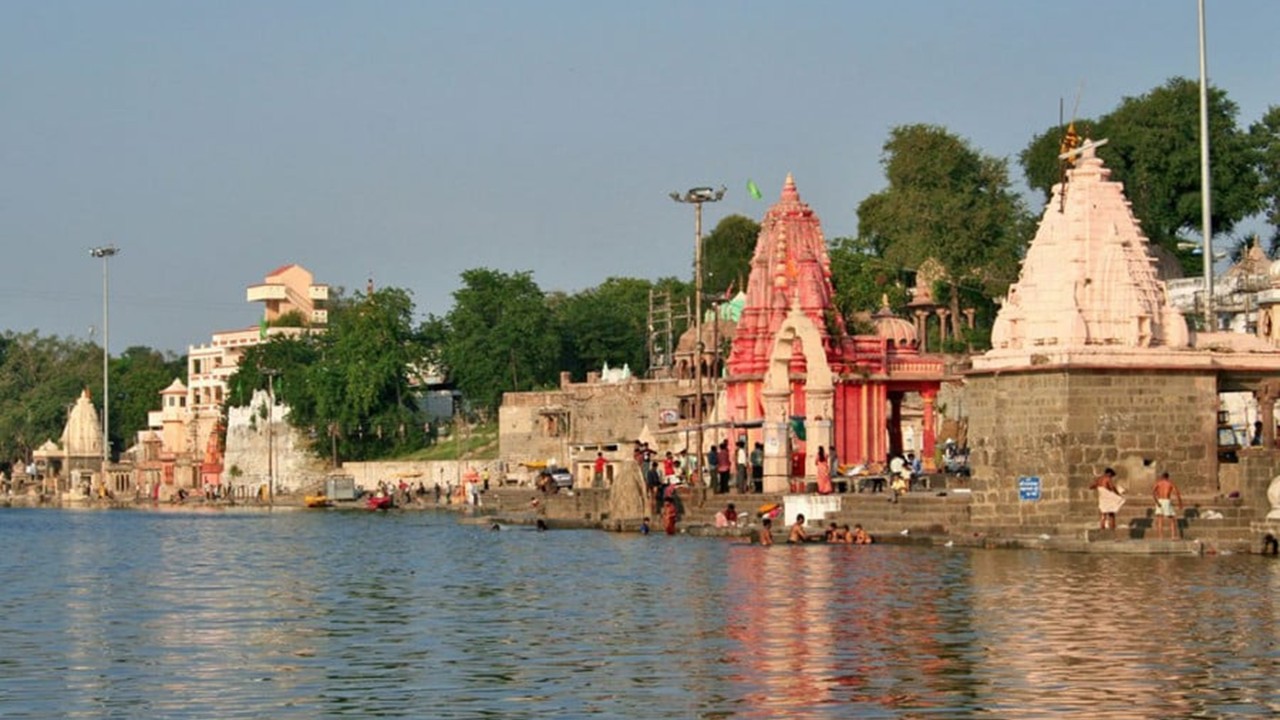
According to local tradition, Sri Rama, accompanied by Sita and Lakshmana, visited the sacred banks of the Shipra River at Ujjain and performed the tarpan and pinda pradana for his father, King Dasharatha. The site where these ceremonies were conducted became known as Ram Ghat, one of the sacred ghats on the banks of Shipra River. Since then, the ghat has been regarded as an especially auspicious place for shraddha, tarpan, and other ancestral rites.
Another interesting story associated with the Shipra River explains her title Jvaraghni, “the destroyer of fever.” The Skanda Purana narrates that during the conflict between Sri Krishna, Bhagavan Shiva, and Banasura, terrible personified fevers, named as Vishnu Jvara and Shiva Jvara emerged from their divine weapons. These destructive forces raged across the worlds until they entered the waters of Shipra, where their powers were extinguished. Because she destroyed these fearsome jvaras, the river got the name Jvaraghni.
According to Kumbh Mela tradition, during the Samudra Manthana (churning of the ocean), drops of amrita fell at four places on Earth: Prayagraj, Haridwar, Nashik, and Ujjain. The Shipra River is therefore revered as one of the sacred rivers connected with this celestial nectar. This event forms the basis of the Simhastha Kumbh Mela celebrated on its banks.
The sanctity of Shipra is inseparable from her connection with Mahakaleshwar, the presiding deity of Ujjain. The Skanda Purana portrays Mahakalavana, the sacred region surrounding Ujjain, as one of the sacred places on earth. Flowing through this divine landscape, Shipra becomes the river through which pilgrims purify themselves before approaching Mahabaleshwar.
Festivals
Shipra River is the spiritual heart of Ujjain and hosts numerous religious festivals throughout the year, attracting pilgrims from across Bharat. The Puranas repeatedly emphasizes the extraordinary merits obtained by bathing in the Shipra River. A single dip in this river is said to destroy sins accumulated over countless births. Doing acts of charity, ancestor offerings, and mantra recitation performed on her banks are believed to yield extraordinary spiritual benefits.
The most prominent celebration is the Simhastha Kumbh Mela, held once every twelve years, when millions of devotees, saints, and sadhus gather on her banks to take a sacred bath. The river also witnesses large congregations during Kartik Purnima, Makar Sankranti, Akshaya Tritiya, Vaishakha Purnima, and Mahashivaratri, when pilgrims perform ritual bathing, charity, ancestor offerings, and worship of Bhagavan Shiva at the nearby Mahakaleshwar Jyotirlinga.
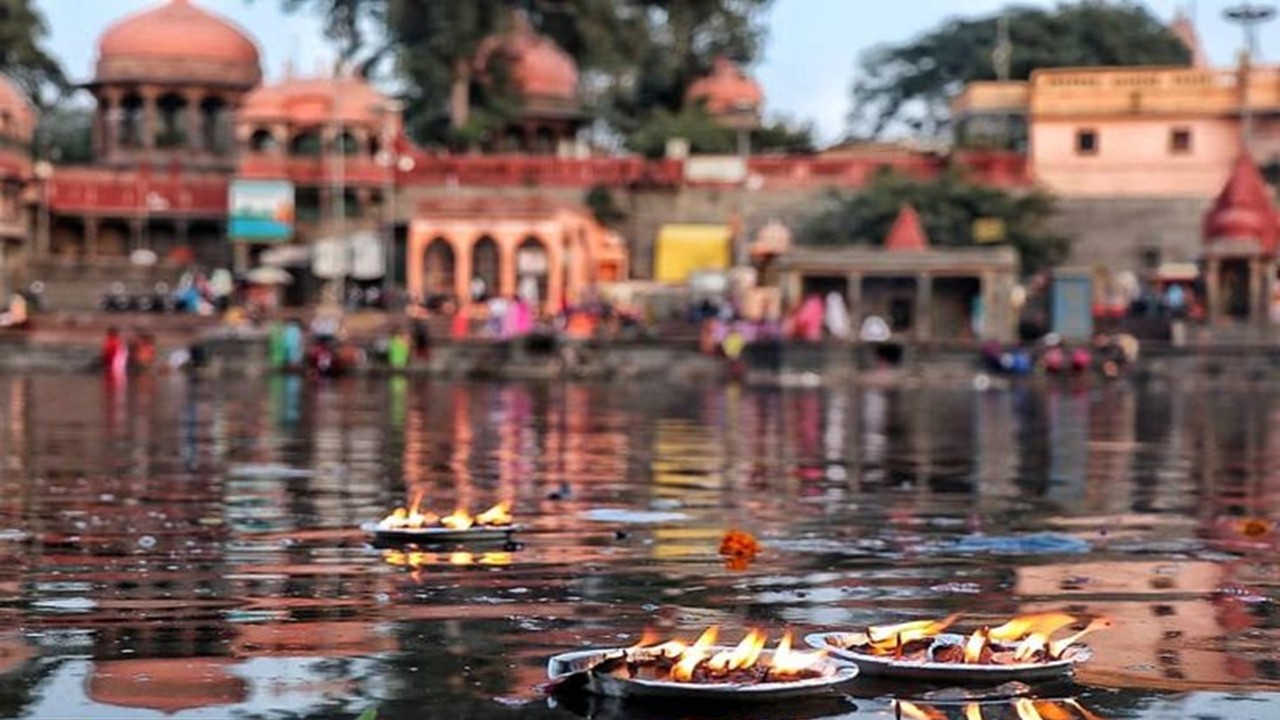
In addition, devotees celebrate Kshipra Jayanti, honoring the divine manifestation of the river, while the daily Shipra Aarti at the ghats fills the atmosphere with devotion through the offering of lamps, prayers, and Vedic chants to the river.
Best Time to Visit Shipra River
The best time to visit Shipra River is from October to March, when the weather in Ujjain is cool and pleasant, making it ideal for visiting the ghats, taking a dip, attending the evening Shipra Aarti, and for visiting the Mahakaleshwar Jyotirlinga. Devotees seeking a spiritually enriching experience may also plan their visit during important festivals such as Kartik Purnima, Makar Sankranti, Mahashivaratri, or the grand Simhastha Kumbh Mela, when the riverbanks come alive with religious ceremonies and devotional activities. While the monsoon season from July to September enhances the scenic beauty of the river with fuller water levels, summer months can be quite hot, making early morning and evening visits more comfortable.
Nearby Places to Visit
Mahakaleshwar Jyotirlinga Temple – One of the twelve sacred Jyotirlingas of Bhagavan Shiva. It is Ujjain’s most revered pilgrimage site and lies just a short distance from the banks of the Shipra River.
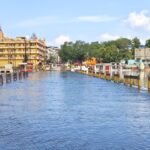
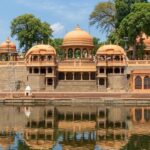
Ram Ghat – The most famous ghat on the Shipra River, where Sri Rama performed shraddha for King Dasharatha. Ancestral rites, the evening Shipra Aarti, and the Simhastha Kumbh Mela takes place here.
Harsiddhi Temple – Revered as one of the important Shakti temples of Bharat, this temple is where Sati’s elbow (kurpara) fell and is known for its towering deepasthambhams (lamp pillars).
Sandipani Ashrama – This sacred ashrama is traditionally believed to be the place where Sri Krishna, Balarama, and Sudama received their education under Guru Sandipani.
Mangalnath Temple – Considered the birthplace of Mangala graha (Mars) according to the tradition, the Mangalnath Temple is an important center for astrological and spiritual worship.
How to Reach Shipra River?
The easiest way to plan your visit is through Tirtha Yatra’s Ujjain Yatra package, which takes care of all the arrangements so that devotees can focus solely on the spiritual experience.

By Air: The nearest airport is Devi Ahilyabai Holkar Airport in Indore, about 55 km from Ujjain. From the airport, taxis and buses are readily available to reach the Shipra River.
By Train: The Ujjain Junction Railway Station is well connected to major cities across Bharat. The Shipra River ghats, including Ram Ghat, are just a short drive from the station.
By Road: Ujjain is easily accessible by road from Indore, Bhopal, Dewas, and other major cities of Madhya Pradesh. Regular buses and taxis operate to the city, from where the Shipra River can be reached easily.
0

Leave a Reply