
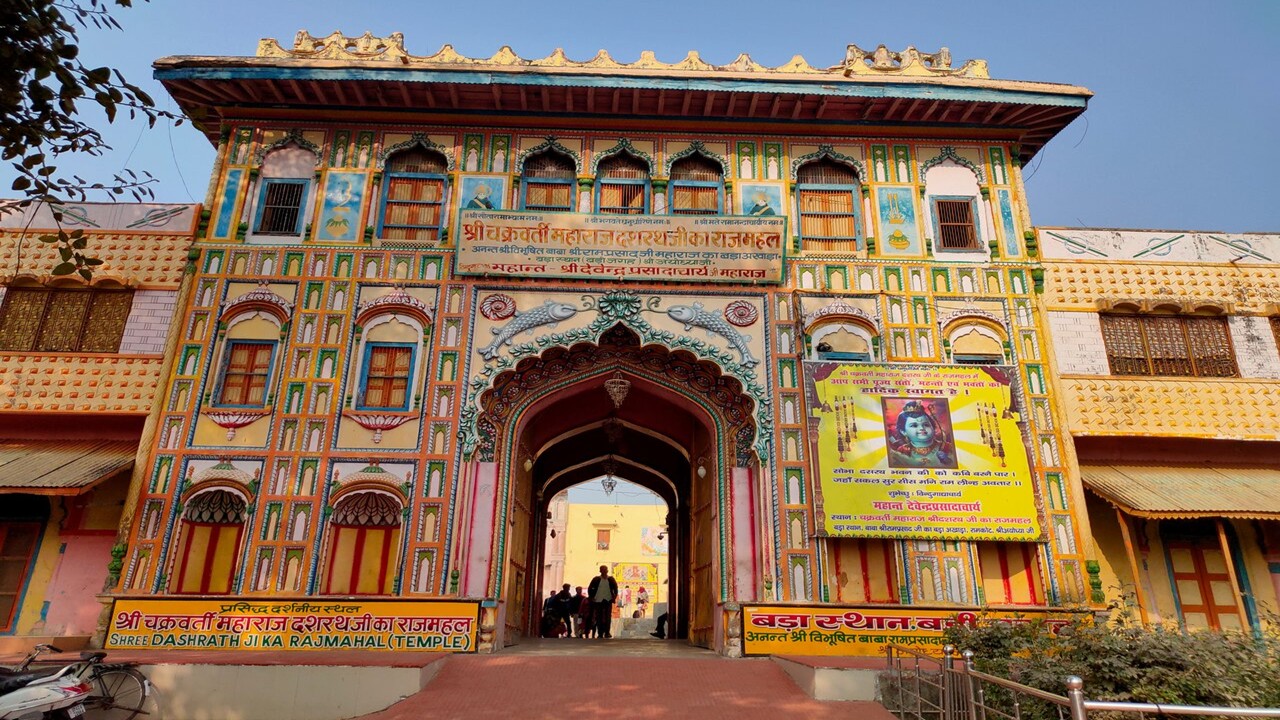
Dasharath Mahal, traditionally revered as the royal residence of King Dasharatha, is a prominent palace-temple in Ayodhya where devotees remember the childhood pastimes and royal life of Sri Rama and His family. While Sri Ram Janmabhoomi celebrates the divine birth of Sri Rama, Dasharath Mahal preserves the memory of the royal household where Rama grew up under the loving care of King Dasharatha and Queen Kausalya.
Tradition identifies this site as the palace of the Solar Dynasty kings of Kosala and the residence of the four princes – Rama, Bharata, Lakshmana, and Shatrughna. Today the palace survives as a vibrant temple complex in the Ramkot area of Ayodhya, not far from Hanuman Garhi and Ram Janmabhoomi.
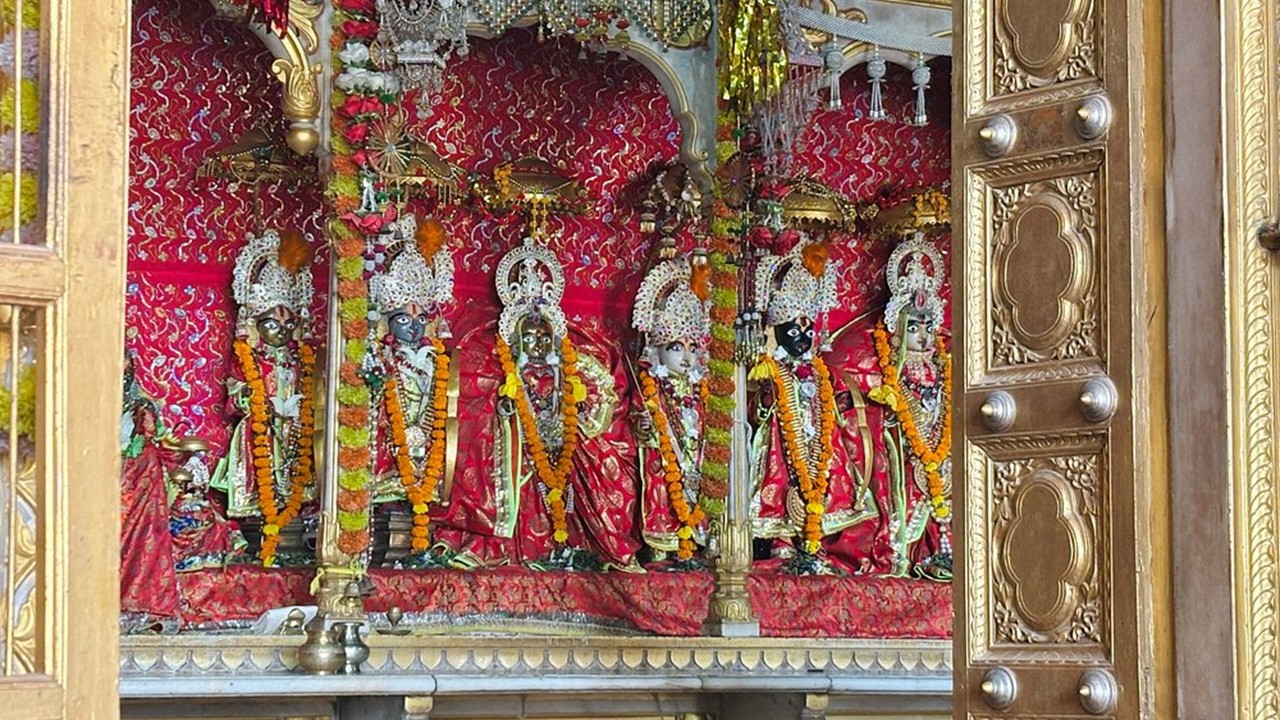
It is revered as a sacred Siddha Peetha and is primarily a Rama-Parivara temple, where Sri Rama, Sita Devi, Lakshmana, Bharata and Shatrughna are worshipped. It is the very stage upon which some of the most significant episodes of the Ramayana unfolded: the birth of the divine princes, preparations for Rama’s coronation, Kaikeyi’s fateful boons, and the heartbreaking departure of Rama to the forest.
The origins of Dasharath Mahal are inseparable from the glory of Ayodhya itself. The city is celebrated in the Valmiki Ramayana as the capital of the Kosala Kingdom and the seat of the Ikshvaku dynasty, also known as the Suryavamsha or Solar Dynasty. Ayodhya was founded by Vaivasvata Manu, while his son Ikshvaku became its first king.
Sthala Purana of Dasharath Mahal
Dasharath Mahal is deeply rooted in the Ramayana tradition. Although the current structure is not the original palace from the Treta Yuga, the site commemorates the royal residence described in the Valmiki Ramayana. For centuries, saints of the Ramanandi tradition have preserved its sanctity and sustained its importance as a center of devotion to Rama.
According to Sri Valmiki Ramayana, King Dasharatha remained childless for many years despite possessing immense wealth, power, and virtue. Concerned about the future of his kingdom, he performed the Putrakameshti Yajna under the guidance of Sage Rishyasringa. The celestial sacrifice pleased the devatas, and a divine being emerged from the sacrificial fire carrying a vessel of sacred payasa. Dasharath distributed this heavenly offering among his queens Kausalya, Kaikeyi, and Sumitra.
As a result, Sri Mahavishnu incarnated as Rama, while Bharata, Lakshmana, and Shatrughna were also born as divine princes. Temple tradition identifies Dasharath Mahal as the royal residence where these miraculous births were celebrated. The palace thus became one of the earliest spaces associated with the earthly life of Sri Rama. Every courtyard within the complex recalls the joyous days when the divine child Rama played within these royal halls.
One of the most dramatic events in the literature unfolded within the walls of Dasharath Mahal. As Sri Rama reached adulthood, King Dasharatha decided to crown him heir to the throne. Ayodhya erupted in celebration, and preparations for the coronation commenced throughout the royal city. However, Queen Kaikeyi invoked two boons previously granted to her by Dasharatha. She demanded that Bharata be crowned king and that Sri Rama be exiled to the forest for fourteen years.
The king was devastated but remained bound by his word. It was from this palace that Rama departed on his exile accompanied by Sita Devi and Lakshmana. Unable to bear the separation, Dasharath later passed away in grief. Thus, Dasharath Mahal became the setting for one of the most moving episodes in the Ramayana.
History of Dasharath Mahal
Dasharath Mahal no longer preserves its original Ramayana-era structure. The present temple-palace complex reflects centuries of reconstruction and renovation by devotees and religious institutions, with some modern traditions attributing a later restoration to Vikramaditya II of the Chalukya dynasty.
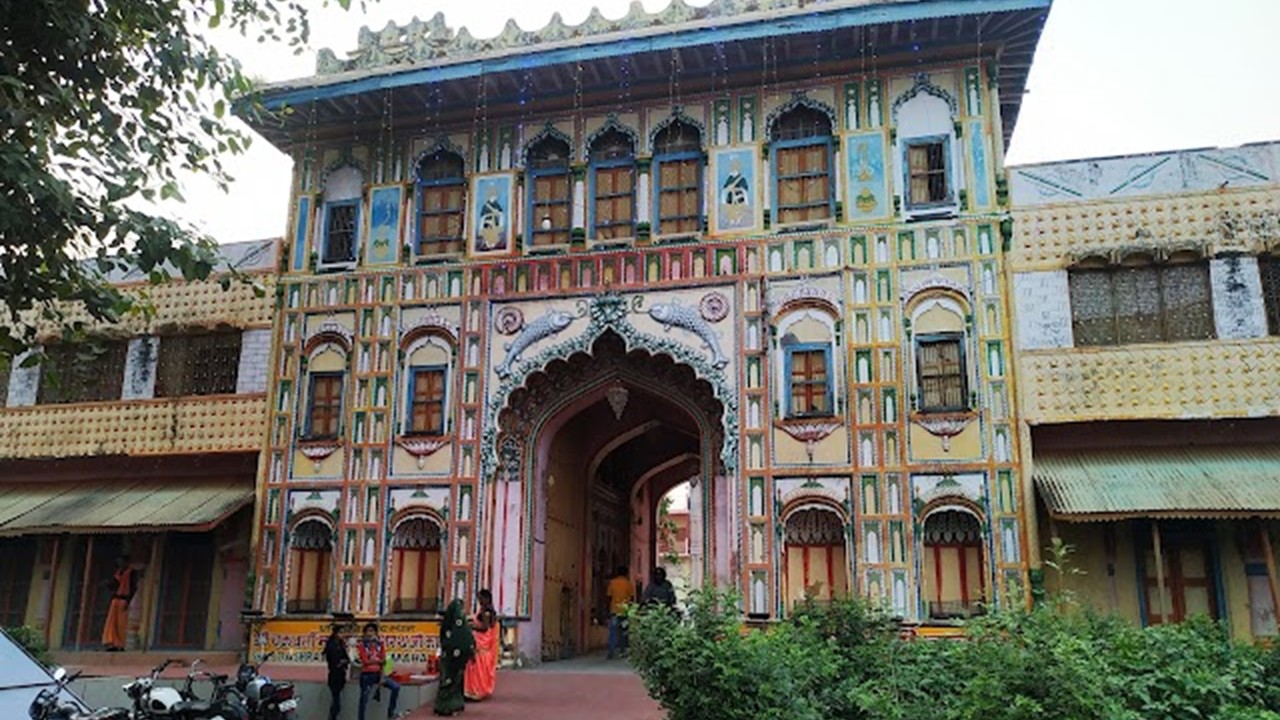
Also known as Dashrath Bhawan and Badi Jagah, the temple holds a prominent place in Ayodhya’s Vaishnava tradition. Despite changes in political rule, continuous pilgrimage and worship have preserved its identity as the palace of Sri Rama’s father.
Despite political upheaval in Ayodhya during the medieval and colonial periods, local devotional communities and monastic institutions kept Dasharath Mahal active as a place of worship. Its continuous religious tradition, rather than a status as merely a historical monument, remains one of its defining features.
Architecture
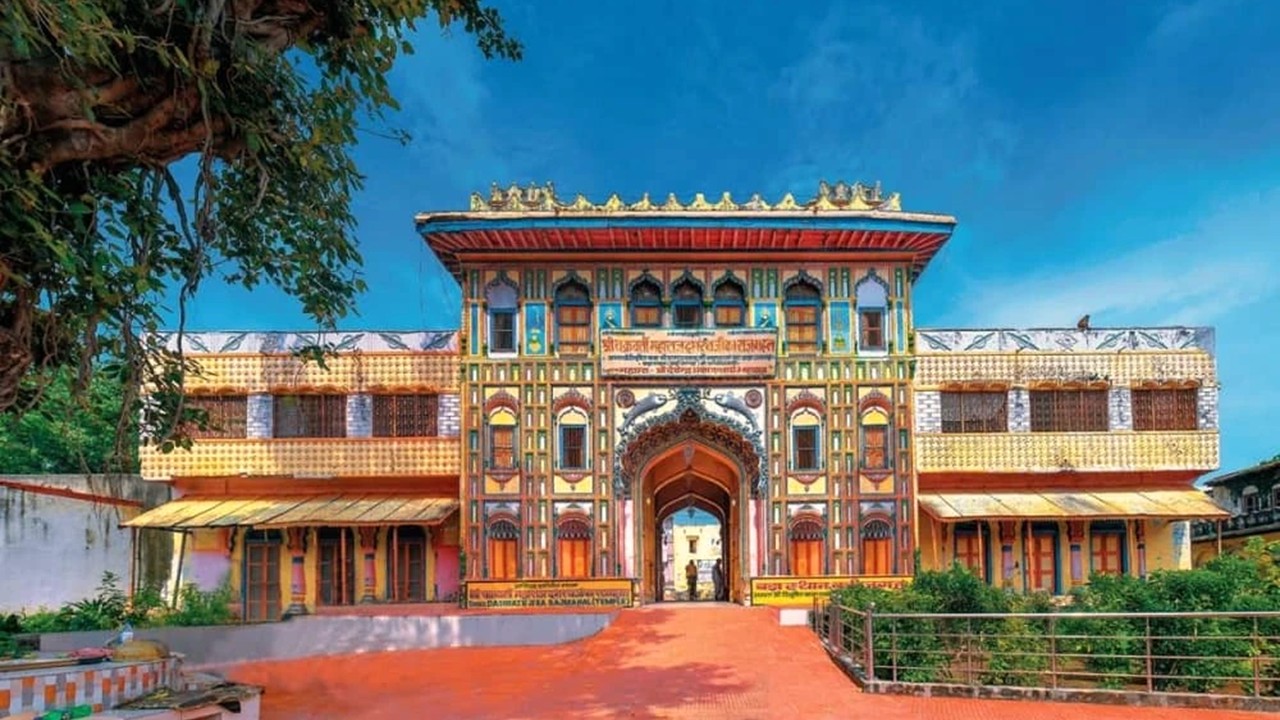
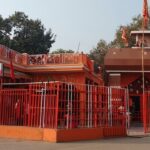
Dasharath Mahal appears as a vibrant palace-temple with the entrance immediately captures attention through its colourful facades, decorative arches, intricate carvings, and richly painted walls. Bright shades of yellow, pink, blue, and gold symbolize royal splendour and divine celebration.
Inside, visitors encounter spacious courtyards, pillared halls, balconies, altars, and devotional gathering spaces. Beautiful Ramayana-themed murals adorn many walls, visually narrating key episodes from the Ramayana. Continuous chanting, bhajans, and kirtans create an atmosphere more reminiscent of a living palace than a conventional temple.
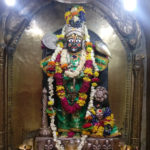
The architecture reflects a blend of North Indian temple tradition and royal palace aesthetics. The principal deities include Sri Rama, Sita Devi, Lakshmana, Bharata, and Shatrughna, often depicted in royal attire befitting the princes of Ayodhya. There is also an altar dedicated to King Dasharatha within the palace campus.
Festivals
Dasharath Mahal celebrates several festivals connected to the life of Sri Ramachandra, with Rama Navami and Diwali (Deepotsava) being the grandest. During these occasions, the temple is beautifully decorated, and special pujas, bhajans, and processions attract thousands of devotees.
Other important celebrations include Vivah Panchami (the wedding of Sri Rama and Mata Sita), Jhulan Utsav, Makar Sankranti, and Sharad Purnima. Throughout the year, devotional singing and Ramayana recitations keep the spirit of Rama bhakti alive at Dasharath Mahal.
Darshan Timings of Dasharath Mahal
The palace-temple is open on all the days of the year between 08:00 AM to 12:00 PM and 4:00 PM to 10:00 PM
Best Time to Visit Dasharath Mahal
The best time to visit Dasharath Mahal is from October to March, when the weather in Ayodhya is pleasant for temple visits. For a grand spiritual experience, visit during Rama Navami and Diwali, when the temple is beautifully decorated and filled with devotional celebrations. Early mornings and evenings offer the most peaceful and devotional atmosphere for darshan.
Nearby Places to Visit
Hanuman Garhi: Tradition holds that Hanuman resided at this temple to guard Rama’s kingdom after his return to Ayodhya.
Ram Janmabhoomi Mandir: The sacred birthplace of Sri Rama situated approximately 500 metres from Dasharath Mahal.
Kanak Bhavan: Known as the “Golden Palace” of Ayodhya, Kanak Bhavan is revered as the palace gifted by Queen Kaikeyi to Sita after her marriage to Sri Rama.
Sugriva Kila: This place is traditionally believed to have been gifted by Sri Rama to King Sugriva after the victory over Lanka.
Ratna Simhasana: This throne is traditionally regarded as the royal seat where Sri Rama was crowned after his return from exile and ruled Ayodhya during the era of Rama Rajya.
How to Reach Dasharath Mahal?
The easiest way to plan your visit is through Tirtha Yatra’s Ayodhya Kashi Tour package, which takes care of all the arrangements so that devotees can focus solely on the spiritual experience.

By Air: The nearest airport is Maharishi Valmiki International Airport, Ayodhya, which is well connected to major Indian cities. From the airport, pilgrims can hire taxis or cabs to reach Dasharath Mahal, located in the heart of the Ramkot area.
By Rail: The nearest railway station is Ayodhya Dham Junction, one of the principal railheads with regular trains connecting Ayodhya with major destinations across India. From the station, autorickshaws, e-rickshaws, and taxis are readily available to reach the temple.
By Road: Ayodhya is well connected by a network of National and State highways. Regular buses, taxis, and private vehicles operate from nearby cities such as Lucknow, Varanasi, and Prayagraj.
0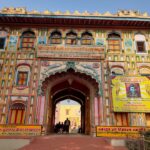
Leave a Reply