
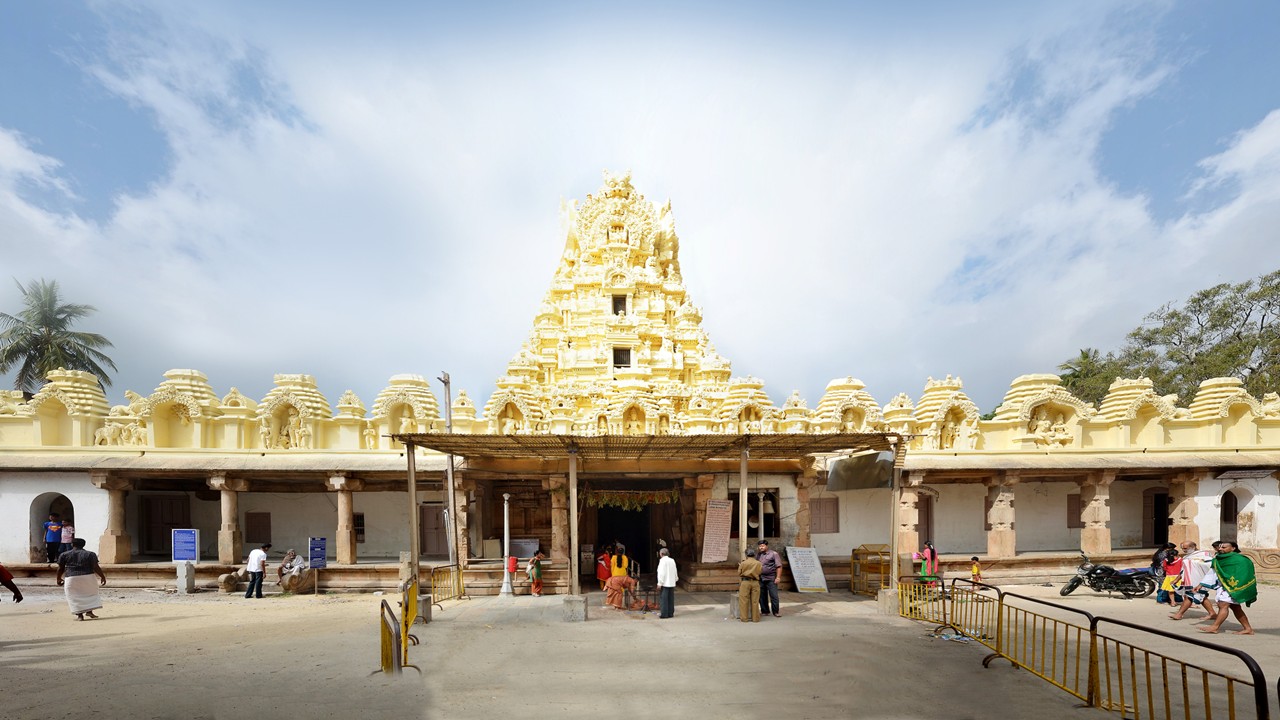
Cheluvanarayana Swamy Temple of Melkote stands among the most revered Vaishnava centres in South India. Celebrated as Tirunarayanapura, Yadavadri, and Dakshina Badarikashrama, this sacred kshetra is amidst the Yadugiri Hills of Karnataka. It has long been a foremost center of Sri Vaishnavism and owes much of its spiritual prominence to Sri Ramanujacharya, who established Melkote as a great seat of the Vishishtadvaita tradition.
Recognized as one of the 108 Abhimana Kshetrams of the Vaishnava tradition, the temple’s present form is closely associated with Sri Ramanujacharya. Guided by a divine vision, the acharya arrived at Melkote, where he discovered the sacred vigraha of Tirunarayana and consecrated it in 1099 CE.
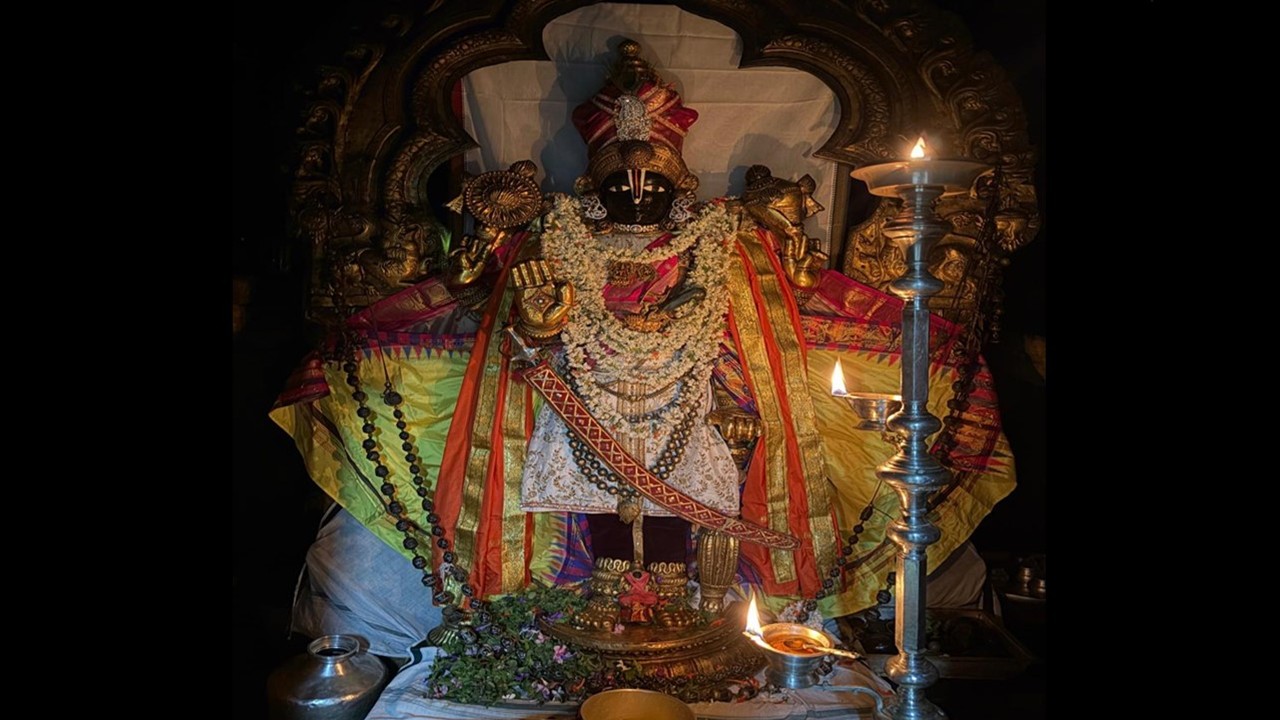
The presiding deity, Sri Cheluvanarayana Swamy, is worshipped as Tirunarayana, the enchanting standing form of Sri Mahavishnu. The deity here is in a graceful four-armed posture, holding the Shankha, Chakra, Gada, and Padma, symbolizing divine sovereignty, protection, strength, and purity.
The beloved utsava murti, Sri Ramapriya, also known as Sampath Kumara, embodies the intimate bond between the Lord and His devotees, and is magnificently decorated during the renowned Vairamudi Utsava, where he manifests himself in unparalleled royal splendour.
Sthala Purana of Cheluvanarayana Swamy Temple
Cheluvanarayana Swamy Temple of Melkote is believed to have its origins in the Satya Yuga. According to temple lore, Sriman Narayana gifted His own divine deity to Brahma for daily worship. In time, Brahma entrusted this sacred murti to his son Sanatkumara, who installed it on the hill that later became renowned as Melkote. Owing to this divine association, the sacred kshetra came to be known as Vedadri and Narayanadri, reflecting its sanctity as a hill blessed by Vedic wisdom and celestial worship.
Sri Vaishnava traditions further describe Melkote as a timeless center of Sri Vishnu worship that has remained sacred through all four yugas. This hill was known as Vedadri in Krita Yuga, Narayanadri in Treta Yuga, Yadavadri in Dvapara Yuga, and Yathishaila, or Tirunarayanapura, in Kali Yuga following the arrival of Sri Ramanujacharya. Because of its immense spiritual significance, Melkote is often revered as Dakshina Badarikashrama, the southern counterpart of Badrinath.
Among the most cherished traditions of Melkote is the story of the utsava murti, Sri Ramapriya or Sampath Kumara. Temple tradition states that when Brahma sought another deity for worship, Sriman Narayana gifted him a beautiful metal deity. This deity was later worshipped by Sri Rama, earning the name Ramapriya, and was subsequently passed down to the Yadava lineage associated with Sri Balarama.
The divine Vairamudi, the diamond-studded crown of Sri Cheluvanarayana Swamy, originally belonged to Sri Mahavishnu. A demon king named Virochana, son of Prahlada Maharaja, stole the divine crown from Vaikunta, but Garuda, Sri Vishnu’s celestial vahana, defeated him, recovered the crown, and presented it to Sriman Narayana here. Since then, the crown has been revered as the sacred Vairamudi, and during the annual Vairamudi Brahmotsava at Melkote, it is ceremonially adorned on the utsava murti Ramapriya, drawing thousands of devotees.
The Varaha Tirtha, identified with Melkote’s sacred Kalyani Pushkarini, is closely linked to Sri Vishnu’s Varaha Avatara. When Sri Varaha rescued Bhudevi from the cosmic waters, a drop of sweat from Varaha’s body fell at Melkote, forming this tirtha. Devotees traditionally take a sacred bath here before the darshan of Sri Cheluvanarayana Swamy.
History of Cheluvanarayana Swamy Temple
Cheluvanarayana Swamy temple’s transformative chapter in history began in the 12th century with the arrival of Sri Ramanujacharya. Forced to leave Srirangam during a period of religious conflict, Ramanuja took refuge in the Hoysala kingdom and settled in Melkote for more than a decade.
After becoming the Rajaguru of the Hoysala Empire, Sri Ramanujacharya was divinely guided by Sri Vishnu to Melkote in a dream. Tradition holds that he came in search of the sacred namam clay used for the Sri Vaishnava Urdhva Pundra and, during his journey, discovered the buried vigraha of Tirunarayana. He consecrated the deity at Melkote in 1099 CE according to Pancharatra Agama traditions and established regular worship, laying the foundation for Melkote’s rise as a major Sri Vaishnava center.
With the patronage of King Vishnuvardhana of the Hoysala dynasty, the temple was subsequently developed and completed around 1104 CE, emerging as one of the most important spiritual centres of southern Bharat.
Among the most captivating Leelas in Melkote is the story of Bibi Nachiyar, a Muslim princess whose devotion to Ramapriya became an enduring symbol of love beyond all social and cultural boundaries. According to temple tradition, the beloved utsava murti, Sri Ramapriya (Sampath Kumara), was taken to the court of the Sultan of Delhi during a period of turmoil.
When Sri Ramanujacharya journeyed north to recover the, he discovered that the Sultan’s young princess had developed an extraordinary affection for the divine deity and treated it as her constant companion. Temple lore narrates that when Sri Ramanujacharya lovingly called out, “Cheluva Pillai!” (“Beautiful Child”), the deity miraculously came to him.
Unable to bear separation from the deity, the princess followed the acharya all the way to Melkote. Her devotion was so pure and unwavering that she eventually dedicated her entire life to the service of Ramapriya and is believed to have attained eternal union with Him. To this day, she is revered in temple tradition as Bibi Nachiyar, and a special altar and rituals commemorate her devotion.
Architecture of the Temple
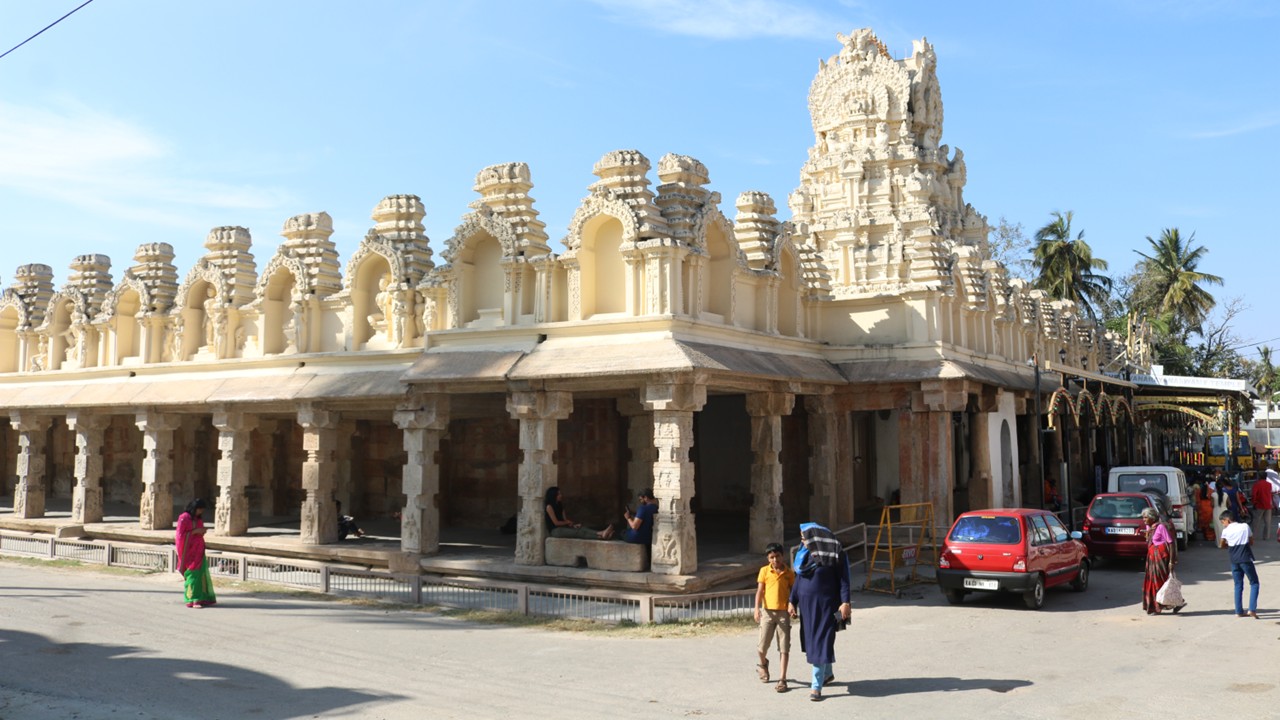
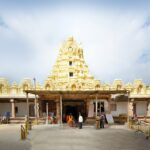
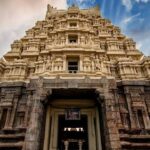
Cheluvanarayana Swamy Temple reflects centuries of architectural development under the Hoysalas, Vijayanagara rulers, and Mysore Wadeyars. The temple complex is built primarily in the Dravidian style while incorporating regional Karnataka influences.
Massive prakaras, pillared halls, ornate gateways, and beautifully sculpted mandapas characterize the complex. The temple tank known as Kalyani or Pushkarani is another architectural highlight. The divine consort of Sriman Narayana is worshipped as Yadugiri Nachiyar or Yadugiriyamma. The temple complex also houses the beloved utsava murti Ramapriya as well as Bibi Nachiyar.
Overlooking the town from the summit of Yadugiri Hill stands the famous Yoga Narasimha Temple, which is closely connected with the worship traditions of Cheluvanarayana Swamy. Pilgrims traditionally visit both temples during their yatra.
Among its most treasured possessions are the Rajamudi, gifted by Raja Wodeyar, the Krishnarajamudi, donated by Krishnaraja Wadeyar III, and the stunning diamond-studded Vairamudi, a jewel-studded diamond crown believed in tradition to have been brought by Garuda himself. These sacred crowns are used to adorn Sri Cheluvanarayana Swamy during major festivals and are kept under government custody, being brought to the temple only on designated ceremonial occasions.
Festivals
Vairamudi Brahmotsava: The grandest festival of Melkote, celebrated during the Panguni/Phalguna period. The highlight is the night procession of Sri Cheluvanarayana Swamy adorned with the iconic diamond-studded Vairamudi Crown, drawing lakhs of devotees.
Rathotsava: A magnificent chariot procession in which devotees pull the temple car carrying Sri Ramapriya through the streets of Melkote.
Teppotsava: The utsava deity is taken in a beautifully decorated float across the sacred temple tank, accompanied by Vedic chanting and devotional music.
Vaikuntha Ekadashi: One of the most important Vaishnava festivals, celebrated with special pujas, recitation of the Divya Prabandham, and a grand darshan.
Sri Ramanuja Jayanti: Commemorates the birth anniversary of Sri Ramanujacharya, whose association with Melkote transformed it into a major center of Sri Vaishnavism.
Panguni Uthiram: Celebrated with special rituals and processions for Sri Ranganatha and Yadugiriyamma.
Darshan Timings of Cheluvanarayana Swamy Temple
The temple is open on all the days of the year between 07:30 AM to 01:00 PM and 04:00 PM to 8:00 PM
Best Time to Visit Cheluvanarayana Swamy Temple
The best time to visit Cheluvanarayana Swamy Temple in Melkote is from October to March, when the weather is cool and pleasant, making it ideal for temple visits, and exploring the sacred sites around the town. The post-monsoon landscape is also particularly beautiful, with lush greenery adding to the spiritual charm of the pilgrimage destination.
Nearby Places to Visit
Yoga Narasimha Swamy Temple: Situated atop the sacred Yadugiri Hill, this temple is dedicated to Sri Narasimha in a yogic posture, installed by Prahlada Maharaja.
Varaha Tirtha (Kalyani Pushkarini): This magnificently stepped temple tank, also known as the Melkote Kalyani, was created by Sri Varaha’s sweat droplet.
Akka-Tangi Kola: Known as the “Twin Sacred Ponds,” these theerthas are associated with local temple traditions and are considered spiritually purifying.
Yoganandeshwara Temple: After Sri Narasimha’s fierce manifestation at Yadugiri Hill, Bhagavan Shiva appeared here as Yoganandeshwara to calm and balance the divine energies.
How to Reach Cheluvanarayana Swamy Temple?
By Road: Melkote is about 50 km from Mysuru and 130 km from Bengaluru. Regular KSRTC buses, taxis, and private vehicles well connect Melkote.
By Rail: The nearest major railway station is Mysuru Junction, about 50 km away. From the station, taxis and buses are readily available to reach Melkote.
By Air: The nearest airport is Mysuru Airport (about 60 km), while Kempegowda International Airport, Bengaluru is approximately 170 km away. Taxis and buses are available.
0
Leave a Reply