
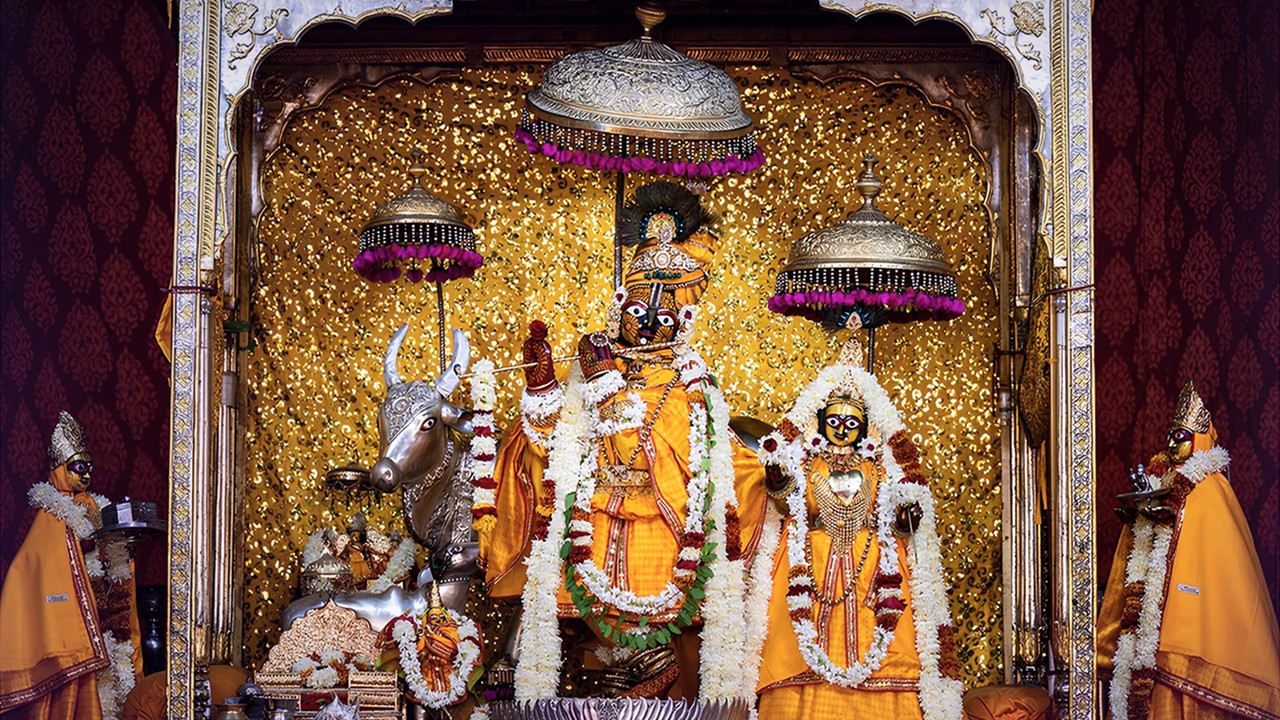
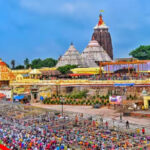
Govind Dev Ji Temple is one of the most revered Sri Krishna temples in Rajasthan, known for its marvelous architectural splendor. It stands as a testament to Jaipur‘s rich spiritual heritage and architectural grandeur.
Govind Dev Ji Temple is situated within Jaipur’s City Palace complex in Rajasthan’s Jaipur district; it is renowned for both its spiritual significance and magnificent architecture. Dedicated to the worship of Govind Dev Ji, a form of Lord Sri Krishna along with Radha Rani, the temple attracts countless devotees.
Govind
Dev Ji Temple is a divine site that follows the Gaudiya Vaishnava philosophy. It is a sect in Hinduism that prioritizes, only through pure devotion can one attain the lotus feet of Lord Sri Krishna. They worship Lord Sri Krishna, along with His eternal consort, Srimati Radha Rani.Amber’s ruling Kachwaha family honored Govind Dev Ji as their principal Deity. This awe-inspiring temple is nestled within the City Palace complex, positioned between the Badal Mahal and the Chandra Mahal. The vibrant Deity of Govind Dev Ji is famously known as “Vajrakrita” because it was created by Vajranabha.
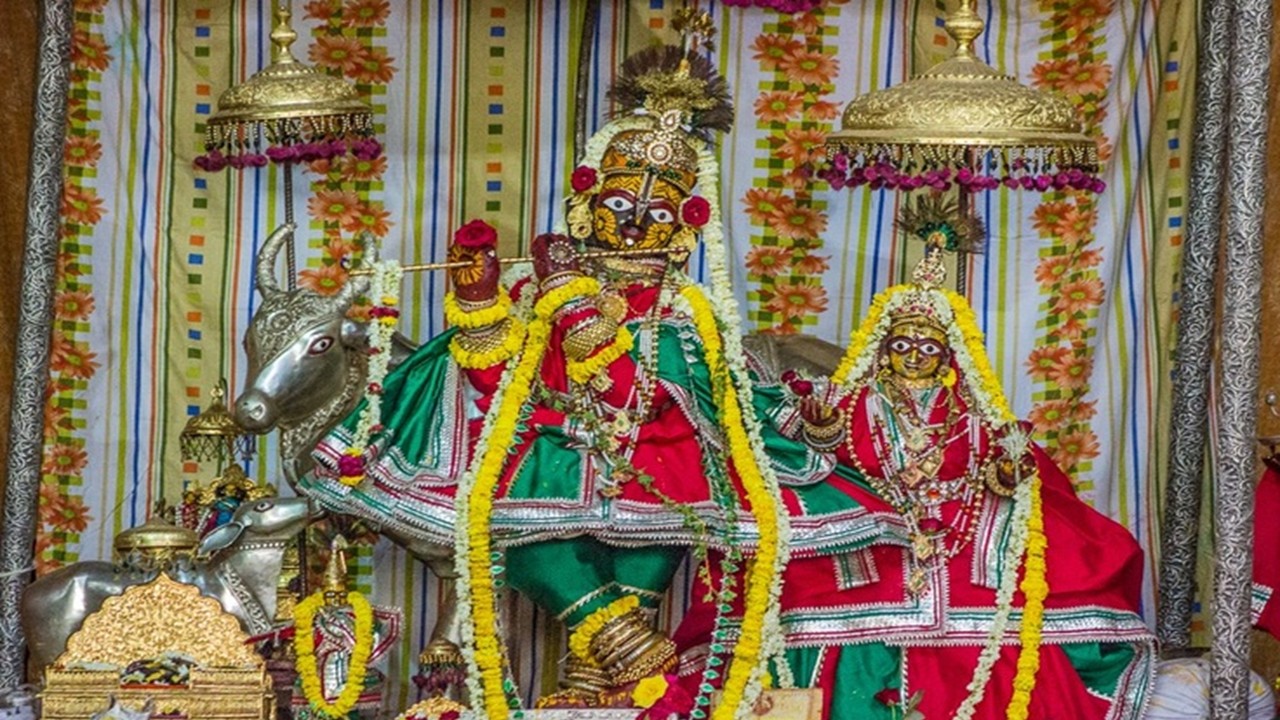
Sthala Purana of Govind Dev Ji Temple
According to history, Vajranabha, also known as Vajra, was the son of Aniruddha and Usha, making him the great-grandson of Lord Sri Krishna. He is credited with revitalizing the Vraja Bhumi, then desolate into a vibrant spiritual landscape. He effectively restored the Pauranic Yadava dynasty known as the Yaduvamshis.
As per the instruction given by Uttara, he had the Deity of Lord Sri Krishna sculpted when he was only 13 years old. Each time, the Deity of Lord Sri Krishna was sculpted, Uttara rejected it on account of differences with the original figure. Every time he got it sculpted, only one part of the Deity resembled Lord Sri Krishna. The first time, it resembled the lotus feet of Sri Krishna; the second time, it resembled the chest. Finally, the third time, the Deity looked exactly like that of Lord Sri Krishna’s face. Hence the Deity was called ‘Vajrakrita.’ As a child, Vajranabha was very fascinated by the lilas of Lord Sri Krishna. Uttara had narrated many stories describing various qualities of Krishna, such as valor, wisdom, brilliance, truthfulness, artistry, strength, and influence.
Guided by the memories of Uttara, Vajranabha carved three Deities, each capturing different parts of Lord Sri Krishna.
Madan Mohan Ji: Based on the description of Uttara, the Deity beautifully resembles Krishna’s Lotus feet and legs.
Gopinath Ji: It represents Krishna’s chest and arm (torso or trunk region).
Govind Dev Ji: This Deity exactly looked like that of Krishna’s face, which brought tears to the eyes of Uttara.
Initially, the three Deities were worshiped in Vrindavana. To protect the Deities from the Mughal invasion, they were moved to different locations. In the present time, Madan Mohan Ji is enshrined in Karauli, while Gopinath Ji and Govind Dev Ji are revered in Jaipur.
Architecture of Govind Dev Ji Temple
This magnanimous temple showcases the Rajasthani style of architecture, built by Maharaja Sawai Jai Singh II in the year 1735. Sandstone and marble are the materials used for the construction of the temple. The walls of the temple have many intricate carvings depicting scenes from Krishna’s lilas.
Seven Types of Darshans of Govind Dev Ji Temple
Here are the seven darshans of Govind Dev Ji.
- Mangala Aarti: This aarti is performed just before the sunrise to wake up the Govind Dev Ji.
- Dhoop Aarti: While performing aarti, fragrant incense is offered to the Deity. It symbolizes complete surrender and devotion.
- Shringar Aarti: The Lord is dressed in elegant costumes and adorned with beautiful jewelry.
- Rajbhog Aarti: Lunch offerings are made to the Deity.
- Utthapan Aarti: The Lord wakes from His afternoon rest.
- Sandhya Aarti: Evening prayers are performed during the Sandhya aarti.
- Shayan Aarti: During this aarti, the Deity of Govind Ji is made to sleep.
Festivals of Govind Dev Ji Temple
Radhashtami: This festival celebrates Radha Rani’s divine birthday. It is observed in the Bhadrapada maasa (Sept-Oct) Shukla Paksha (Ashtami).
Krishna Janmasthami: This festival is celebrated in great grandeur, filled with electrifying atmosphere of heartfelt devotion, love and joy. At midnight, large number of devotees throng to this temple to have the darshan of Baby Krishna placed in Jhulan (cradle), followed by 31-gun salute, a military honour.
Gopashtami: It falls on the Karthika Maasa. This festival honors Krishna’s role as the Cowherd Boy, symbolizing His care and love for cows and all living beings. On this auspicious day, devotees worship cows by decorating them as a mark of showing gratitude for their life-supporting contribution.
Phag Utsava: In this festival, flowers are used to play instead of colored powders. It is a recreation of Krishna’s divine playfulness, symbolizing love, innocence, and celebrating life in various forms.
Annakuta: It is celebrated one day after Diwali. A huge pile of food, resembling a mountain, is offered to Lord Sri Krishna as a mark of gratitude for His divine blessings and protection.
Temple Timings of Govind Dev Ji Temple
The darshan timings of the Govind Dev Ji temple are as follows:
Morning: 4:30 AM to 12:00 PM
Evening: 5:45 PM to 9:30 PM
Best Time to Visit Govind Dev Ji Temple
October to March is the best time to visit Govind Dev Ji Temple.
Nearby Places to Visit
City Palace: It is a royal palace located in Jaipur, also known as Pink City. This marvelous structure was constructed by Maharaja Sawai Jai Singh II, which is a blend of Rajput and Mughal styles of architecture along with European influence. It houses various courtyards, galleries, restaurants, and offices of the Museum Trust.
Jantar Mantar: It is celebrated as a UNESCO World Heritage Site located in Jaipur. Built in the 18th century by Rajput Maharaja Sawai Jai Singh II. It is a remarkable astronomical observatory to interpret the position of celestial bodies and calculate local time.
Swargasuli Tower: It is also called Isarlat, a seven-story tower in Jaipur, standing 42 meters (140 feet) tall. It showcases the traditional Rajput–Mughal style of architecture, built in 1749 by Maharaja Sawai Ishwari Singh to celebrate the victory of his military forces.
Hawa Mahal: It is an elegant palace built by Maharaja Sawai Pratap Singh in 1799. Red and pink sandstone are used for the construction of the palace. It resembles the Kirita (crown) of Lord Sri Krishna.
Amber Fort: It is located in Amber, just 11 Kms away from Jaipur, Rajasthan. It is located on the hilltop, known for its Hindu-style architecture. Built by Raja Man Singh I, it features ornate palaces, temples, and mirror work in its interiors.
How to Reach Govind Dev Ji Temple?
If you plan to visit the Govind Dev Ji Temple and other sacred places, consider taking Tirtha Yatra’s Pancha Dwarka Yatra. All arrangements for your yatra will be well taken care of.

However, if you prefer to travel on your own, here are a few options.
By Air: Jaipur International Airport, located over 10 Kms away, and Kishangarh Airport, a domestic airport located 100-115 Kms away, are the nearest airports to Jaipur city. From either of the airports, you can easily hire a taxi or a cab to reach the City Palace.
By Railway: Jaipur Junction Railway Station is the nearest railway station. From here, you can hire a taxi to enter the city palace.
By Road: The nearest bus stop is Camp Bus Stop in Sindhi. From here, you can hire a bike, rickshaw, auto-rickshaw, or e-rickshaw.
0
Leave a Reply